August 13, 2007

the importance of math education

There's an article in the New York Times pointing out that it is logically impossible for men and women to have different average numbers of sex partners. Which is a problem, since men and women report significantly different lifetime averages (e.g. 4 sex partners for women, 7 for men in the US, or in Britain 12.7 for men and 6.5 for women). Anyone who is decent at math and remembers the definition of the mean will be able to tell you that in a world with about the same number of men and women, it is impossible for men to have more hetero sex partners than women. Indeed, a mathematician has actually proved it. So, explanations?

1. The researchers say it might be that men have significant numbers of sexual experiences with women who aren't counted in the survey, like prostitutes or women in other countries. That would mean that there's got to be some country somewhere where women have many more sex partners than men, and thus far no one's found it. Also, I question their ability to screen prostitutes out of the survey data.

2. Men and/or women are lying their heads off in what they think are the socially approved directions. I think this is quite likely.

3. Men and women have very different distribution patterns for their data. The mean number of partners must be the same for men and women, but that doesn't mean the median number of partners must be the same. As an example, imagine that there are only 5 men and 5 women in the world, and a total of 13 sexual partnerships. The men have had 0, 1, 3, 4, and 5 sexual partners; the women have had 1, 1, 1, 5, and 5 sexual partners. The mean for both groups is going to be 13/5 = 2.6 partners, but the median number of partners for men is 3, while the median for women is 1. That's a huge percentage difference just because women had a few people with high numbers of partnerships, while most women still had fewer sex partners than most men. Is this likely on a large scale? I don't really think so - it's a lot harder to skew data like that when you're not making it up and there are thousands of people in your data set. But I don't really know, and apparently the social scientists who could find out for us aren't. My best guess still goes to #2.

This is an example of bad math education perpetuating a particular social ill, namely the idea that men get around more than women. To his everlasting credit, the mathematician who inspired the article points out exactly this: that taking this data as accurate works to “reinforce the stereotypes of promiscuous males and chaste females" and may skew self-reporting and behavior. If math education were better, and people understood mean and median and interpreting statistical graphs, and if the news media could therefore publish graphs of the statistics in question, there'd be a lot more ways for people to check stereotypes against reality.

When will those darn math teachers do something about it?

August 12, 2007

authentic schmauthentic

Iowa is a certain kind of hipster heaven. We have trucker hats, dive bars, cowboy boots, soda fountains, and cheap beer. We have craft shows and karaoke.

Only thing is, there aren't any hipsters. This stuff is for real.

August 8, 2007

being home

Everyone talks about the caucuses. Everyone. Instead of "How 'bout that local sports team?" it's "How 'bout that Democratic candidate?" Or occasionally, "Damn, the Republican field is pathetic." Which it is.

I can pretty much do as much running on the bike path down by the river as I want. With the dogs. Best thing ever in the morning? A big fluffy blonde dog and a smaller, sleek brown dog with green eyes chasing rabbits and messing around in the water.

I like my parents but I'm glad I don't live with them.

People remember me. A state rep I volunteered for in college remembers me. My parents' friends want me to move back. Sometimes it's nice to remember that if I want to move back here, there are things I can do.

I drink more here than I drink anywhere else. The average might be down to 2 glasses a night by now, after I cut back a bit. Glass of wine while you cook? Glass of wine with dinner? Go out for a beer with friends? Yeah, I think I'm safe to drive.

Bull testicles. My friend Aroog's birthday party involved bull testicles and karaoke and his little sister trying to get me to go to church with her the next morning. I ate Rocky Mountain oysters (just a smidgen - beans and rice for real dinner), sang "Goodbye Earl" and "Boy Named Sue," and bought Aroog's mom a rum and coke, which is funny because that's what he pours at his infamous New Year's parties. As far as the karaoke went, two of my high school friends have talent. The rest of us have heart.

August 6, 2007

how not to apologize

Michael Ignatieff offers the world's lamest admission of being wrong in the Sunday New York Times Magazine. To summarize: "political judgment is about specifics. But let's not talk about the specifics that could have shown us that this war was a bad bet (and thus help us figure out the next one)! Instead let's talk about general principles of political leadership!"

Ignatieff also says, after quoting Bismarck to the effect that good judgment means you hear the horses of history early, "Few of us hear the horses coming." I saw a debate between Leon Wieseltier and Mark Danner right before the war, and the basic summary of the arguments went as follows: Leon Wieseltier supported the war, arguing that Saddam was really damn bad and Bush was the only chance we had to get rid of him; Danner opposed it, arguing that the Bush administration would do such a bad job with it that it wouldn't be worth it.

Guess who was right?

I think what Iraq actually teaches us is that you can't disregard means. You have to have the whole thing thought through before you're done. And you can't support an entity as incompetent, corrupt, and lawless as the Bush administration to tackle a very complicated, high-stakes WAR.

Which is basically saying that wishing doesn't make it so. I wish Ignatieff - who has a Ph.D. and a political position - would maybe express a little actual remorse for the disastrous war he supported.

July 21, 2007

travel plans

I'm headed to Great Smoky Mountains National Park, where I will be held incommunicado through Sunday, and thence to Des Moines, where I'll have most everything the information age can offer. Even cable!

July 18, 2007

presidential calculuses

So Andrew asked why I'm supporting John Edwards, and brought up some things he's been wrestling with: electability, leadership, and policy positions. All of those things are shorthand for 15 million other things, but here's my best shot at explaining why I'm supporting Edwards. For the people who always read the last page first: it's about policy.

But first, let's talk about something else: experience. Hillary Clinton is the only Democratic front-runner with really serious Washington and policy experience, and even she has very little electoral experience - she's just an insanely savvy person who spent 8 years hearing very directly about the Washington experience of another insanely savvy person. Neither Edwards or Obama has any real experience making day to day government decisions as an executive, or moving bills through Congress in the way a president has to do to be effective. I'm concerned about that, but I'm unwilling to vote for Clinton over it. If Bill Richardson's campaign gets any momentum, I might be interested, but let's put that aside for now.

On to electability. I don't really trust myself to predict who's electable in a general election, and I think that efforts to predict electability have screwed the Democrats six ways from Sunday. Kerry? Gore? Not the world's most electable people (in that Kerry wasn't elected) - yet they were chosen specifically for their electability. So I'm not really playing with that right now. I think Clinton has the most serious electability problem of the three major candidates: the American public is pretty damn sexist, plus she's a very polarizing figure, plus she's kind of varnished, which hasn't been going over well lately. On the other hand, have I mentioned how savvy she and her husband are? Obama's race will likely play against him, but I don't feel completely certain of it. Edwards is doing the worst in the head-to-head general election polls (though Dems reliably beat Reps), but I have some questions about whether the sexism/racism cards would affect Obama and Clinton differently in a polling booth rather than a phone call. I got kind of sick of spinning around in circles about this, so I decided to give up. Also, I think focusing on electability encourages a kind of content-free, passion-free politics that is one of the major problems of the Democratic party.

Leadership: I'm going to talk about race and gender here, since I already talked about my concerns about experience. I feel like I should be supporting Obama or Clinton specifically because I am a feminist and anti-racist. Obama is also super-inspiring for many people, which I think would be great in a president (and speaks some to electability). But ultimately,

It's all about policy. Specifically health, environmental, and economic policies, and specifically because there's pretty good evidence that presidential candidates do what they say they're going to do a lot of the time. Edwards's health care policy is really smart, and I think it could get passed and would work. Universal health care is one of those things that's becoming a middle-class issue in a way that means it'll probably get addressed within the next 5 years or so, and I think it matters a lot who the president is then. Clinton won't put her plan out there, and Obama's is pretty complicated, and I think would have a lot fewer cost-saving effects than the Edwards plan because it doesn't expand the pool of insured people as much, thus keeping risk and premiums higher than they ought to be. Obama's policies over-all are fairly piece-meal: his energy policy is like that as well.

Finally, Edwards has put economic inequality on the table in a way that I think is really, really important.

I would say more but I'm incredibly hungry and I'm leaving town on Sunday. More comparative policy analysis coming in two weeks or so.

(Julie and Andrew: big fat congratulations!)


July 11, 2007

ok, some good news

The Democratic candidates are going to have a gay debate. I mean a debate about gay stuff where Melissa Etheridge and the head of HRC ask them questions. Does the debate itself have a sexual preference? How would we ever know?

I am really really excited about this for some reason. Maybe because I have some hopes it'll cut through some of the not-answering-questions-for-real bullshit that happens a lot with the Democrats. Except for Elizabeth Edwards, of course, but unfortunately she's not running for president.

in which I continue to be appalled

Shorter Bush to Congress: lalalalalala I can't heeeeeeaaaaar you.

Harriet Miers isn't even going to show up. Is there anyone who seriously believes he isn't hiding something pretty damn big?

In other news, the man's approval rating dropped to 29%. How low does it have to go before we can get impeachment?

For serious, call your representative. It is your representative's JOB right now to be submitting impeachment motions. Instructions given here.

p.s. most duh headline ever: White House Is Accused of Putting Politics Over Science.

July 10, 2007

evolutionary psychology and its discontents

There's an article in Psychology Today titled Ten Politically Incorrect Truths About Human Nature. Echidne of the Snakes spent some time doing a point by point refutation, which I suggest you read if you're interested in that sort of thing. Basically, the article itself is a particularly genius example of how Evolutionary Psychology as most people use the term is basically a collection of speculation about the lives of early humans, most of which gets used to justify sexism and crappy appearance politics. Refuting it requires slightly less work than shooting fish in a barrel. You don't even need a gun!

My sister studied bioanthropology (basically, the study of humans using biology, which includes quite a bit of evo-psych) in college, and I remember vividly two conversations about it that I had with her. When she was a sophomore and deciding to study bioanth, she argued that I was just wrong not to accept that differences between men and women were biologically based, and that my feminism was blinding me to the strong evidence for it. Two years later, as a senior, she called me up while I was driving through Utah and asked what she should do. She needed to write a senior paper - like a small thesis - to get honors, which she very much wanted, but she felt like she couldn't in conscience write a paper on any of the bioanth subjects she'd studied because the standards of evidence were so unutterably lame and unconvincing. Two years of study brought her to the conclusion that even at a fancy-pants research university, most evolutionary psychology is a collection of speculation about the lives of early humans.

I have a similar problem with a great deal of political theory, including all social contract theory. These theories rely on some kind of imagined history of early humans: life was "solitary, poor, nasty, brutish, and short," then we all got together, signed the social contract, and turned our power over to the state. Hobbes is one of the most honest about this kind of thing (he doesn't make up rights without explaining where they come from) but still. Wasn't it great when we all signed the social contract? What a great party! No wait, no one was there. IT NEVER HAPPENED. (One of the things I like about Aristotelian political theory is that, while there's a theory of human nature, there's no just-so story about how we came to be this way.)

We know a little more about the lives of early humans in a factual sense than we used to, but we still have essentially zip about social structure. Among other things, it's pretty unreasonable to argue that social evolution just stopped at some point (which is what you have to say for evo-psych to still be relevant, or to use modern hunter-gatherers to learn about ancient hunter-gatherers), when we have very clear evidence that lactose tolerance evolved in some places as recently as 3,000 years ago. Humans continue, however, to be very good at coming up with reasons to justify whatever it is we want to justify right now, including rights, greed, censorship, free speech, monogamy, polygamy, etc.

Evolutionary psychology and political theory share one gigantic missed opportunity. Yes, it would be very very interesting to know more about how human brains really work and have evolved, and yes, it would be very very interesting to know how the social structure of early human societies developed, and think about what implications those have for our ideas about politics and community. Aristotle assumes that humans are by nature social - he doesn't even really imagine an isolated state of being human - and that seems likely to have some foundation (unlike, for example, his transparently bad justification for slavery). There's some serious work to be done matching up science and archeology about early humans with theories about human nature and society. But political theorists (who have some excuse, since they're not scientists or historians) and evolutionary psychologists (who have none, since they claim to be both) have done a pretty dreadful job of it. Too bad!

decision made

I support John Edwards for president. In case you were wondering.

July 9, 2007

the course of human events

I drank some very good peach beer, ate some very good Mexican food (restaurant review coming soon), had Queen Anne cherry sorbetto with dark chocolate gelato (Capogiro: still amazing), took the famous outlaw cattens to their temporary home with a very nice woman and a yappy dog. All this with the Political Schmientist. Then I went to the beach! A Feral Hat reunited, plus some excellent people who are and are not getting married. There aren't enough exclamation points to tell you how I feel about boogie boards! Why don't I live at the beach? Then we spent an hour between exits 113 and 120 on the Garden State Parkway and was late to dinner with my parents. And then my parents were in the LA Times, and then there were various not very surprising revelations and some excellent talk at hat-brunch. I had dinner with a food writer and his wife and aforementioned parents. It's hot. The diner for lunch with Fire Boss and a non-practicing Ph.D. with crazy eyelashes decided we didn't need pie. Got described as 'well-behaved' for the first two times in my life.

Then I drove home, read for a while, ate dinner. Listened to some awesome music, if I do say so myself. Drank another peach beer in the shower. Now I will watch TV.

When will someone make Hotel Yorba into a movie? I want it now!

July 4, 2007

Happy 4th of July. Impeach Bush.

Look. It's the 4th of July. This is a great time to love your country, and celebrate the noble words of the noble documents that started the whole thing. But it's an even better time to talk about how, as people who care what the hell is happening in this country, we have work to do. The gap between the lovely words and the violent and unethical actions should be our concern today. (All links below go to the relevant outrage.)


The history of the present [President of the United States] is a history of repeated injuries and usurpations, all having in direct object the establishment of an absolute Tyranny over these States. To prove this, let facts be submitted to a candid world:

--
He has refused his Assent to Laws, the most wholesome and necessary for the public good.
He has forbidden his Governors to pass Laws of immediate and pressing importance, unless suspended in their operation till his Assent should be obtained; and when so suspended, he has utterly neglected to attend to them.

--
He has called together [judicial] bodies at places unusual, uncomfortable, and distant from the depository of their public Records, for the sole purpose of fatiguing them into compliance with his measures.
--
He has refused for a long time, after such dissolutions, to cause others to be elected.
--
He has made Judges dependent on his Will alone, for the tenure of their offices, and the amount and payment of their salaries.
--

He has affected to render the Military independent of and superior to the Civil power.

--

For protecting them, by a mock Trial, from punishment for any Murders which they should commit on the Inhabitants of these States.

--
For depriving us in many cases, of the benefits of Trial by Jury:
--

For transporting us beyond Seas to be tried for pretended offences

--
For taking away our Charters, abolishing our most valuable Laws, and altering fundamentally the Forms of our Governments:
--
In every stage of these Oppressions We have Petitioned for Redress in the most humble terms: Our repeated Petitions have been answered only by repeated injury. A Prince whose character is thus marked by every act which may define a Tyrant, is unfit to be the ruler of a free people.


Here's how we do it.
1. Call your Representative. The House needs a simple majority to pass articles of impeachment, and there's a Democratic majority right now. Call your Republican Representative too. Tell your Representative that by not calling for impeachment, he or she is failing to represent you and failing to support and defend the US Constitution, which they swear to do when they take the Oath of Office. Contact information is at http://www.house.gov/writerep/.

2. Call your Senator. Contact information is at http://www.senate.gov/general/contact_information/senators_cfm.cfm. The Senate would have to convict, but you're mostly calling to encourage your Senator to support articles of impeachment.

3. Still got energy? Write your local newspaper. Tips for getting in: make it short, find an angle other people aren't using (e.g. a specific reason for Bush to be impeached, not an overview of his crimes).

4. Send this to everyone you know. Better yet, write something to send to everyone you know. Your parents, your friends, your relatives you haven't seen in five years, everyone.

5. Go eat some sweet corn.

Happy 4th of July. Impeach Bush.

July 2, 2007

gym manners (nobody wants to hear that)

I work out (when I work out) at the university gym, which is mostly pretty pleasant. But dude. I mean you, the one in the muscles. The one grunting. The one who drops his weights after every single set. Say it with me: If you can't put it down carefully, don't pick it up. No, again: If you can't put it down carefully, DON'T PICK IT UP.1

Every time you pick up a weight, you know you're going to have to put it down. Every single time. You can apparently gauge your own strength well enough to always pick up something you can't put down, so change your calculations. It's loud, it's distracting, maybe someday you're going to drop it on your toe or hit the mirror or my leg. If you can't put it down carefully, don't pick it up.

Oh, and stop with the grunting already. Nobody wants to hear that.


1. There are big signs saying that all over the gay gym, where the Gardener used to work out. The gay gym is very very professional. People do things right. You get sessions with a personal trainer as part of your membership. But the guy who used to own it donated to Rick Santorum.

June 30, 2007

served eleven days cold

All year, there was a group of five or ten juniors who just wouldn't do any work. No homework, no classwork, no tests, no nothing. Eventually I figured out why: they'd made a basically rational calculation that it would be less work to pass summer school than to pass my class. 20 days, easy tests, low standards. It drove me crazy, because they were right; but because they didn't care about my class at all, they had no incentive to sit down and shut up or learn anything or care about a goddamn thing I said.

Today, eleven days after the end of the school year, I got a call from the person who's teaching Algebra II at my high school this summer. He's in the same program I'm in, and he's planning to make them work. This ain't your usual summer school.

Revenge, mothafuckas!

June 29, 2007

natural selection

A partial list of selective pressures that modern medicine has made irrelevant to humans in the developed world (and the technology that fixes them):

Good eyesight (glasses, contacts, LASIK)
Easy childbirth (C-section)
To some extent, high sperm count (fertility treatments)
Lactose tolerance (lactaid, abundant and varied food)
Resistance to smallpox, measles mumps rubella, tetanus, diptheria, pertussis, chickenpox, polio, and meningitis (childhood vaccinations)
Resistance to black plague, streptococcus, cholera, infant diarrhea (antibiotics and water treatment)

Is this relevant information? If so, how and why? If not, why not?

June 28, 2007

intellectual communist

Rebecca Charles, owner of Pearl Oyster Bar, where I have never eaten, is suing someone who runs a similar restaurant on the grounds that he is taking her intellectual property. Yeah, he was her sous chef. But gray wainscoting is her intellectual property? Oyster crackers at a seafood restaurant are her intellectual property? Puh-leeze.

This just displays why the whole idea that intellectual property is somehow the same as physical property is silly. There are two macro-level reasons to protect intellectual property: so people have an incentive to invent and design and come up with cool stuff because they'll be able to make money off it, and because it's unfair when someone steals your idea and makes money off it. Unfortunately, that whole incentive thing is kind of getting lost and law is getting reshaped to value only the second one.

This is really what the internet radio copyright issue was about: internet radio stations, most of which make little money, are being required to pay SoundExchange, the royalty organization, a lot more than they previously had to. Worse, their decision is retroactive, which will probably put some of them out of business. This unambiguously reduces the flow of ideas and music and general awesomeness, and is opposed by many smaller artists, who get a lot more exposure through internet radio than regular radio. Similarly, early hip-hop artists could do crazy awesome sampling in which they used little bits of dozens or hundreds or thousands of songs to make a track or an album, which is instrumental to Public Enemy's early sound. In 1991, copyright restrictions tightened; in 2004 the 6th Circuit ruled that NWA sampling an unrecognizable bit of George Clinton constituted copyright infringement. Legal radio play for that kind of sound is over. Now if someone is going to sample another song, they're going to make damn sure they get what they pay thousands of dollars for, so you actually get a less creative sound from sampling as artists play bigger, less altered parts of the sample.

Enforcing the "it's unfair for people to steal your stuff" goal of intellectual property is particularly dumb because it's not like it hurts George Clinton to have an unrecognizable, heavily altered 3-note guitar riff show up in an NWA song. That's very clearly new innovation, new art, the kind of thing that should be a major goal of intellectual property laws, that it makes me a little despairing about the stupidity of the system. It also shows up why it's so dumb to treat intellectual property like an exact analogue of physical property: when someone 'steals' your intellectual property, you can still use it. If you take my electric pencil sharpener, I can't use it anymore. Intellectual property law needs to differentiate more clearly between situations where someone takes your intellectual property and you lose some important use of it (e.g. selling bootleg DVDs) and situations where something you made becomes inspiration (restaurants, books, musicians do this all the time) or part of a new art form in a way that doesn't limit your use (sampling).

By these standards, I think it's pretty clear that Ed's Lobster Bar gets to have gray wainscoting and a marble bar. And he may win, but I wish people would stop with the rhetorical equating of intellectual and physical property already. Especially since just about everything owes some kind of intellectual debt to someone, including all those musicians SoundExchange alleges to protect, making it almost impossible to tell where these lines should be drawn. Are we now going to prosecute all the Beatles rip-off bands? Every angsty teen-age girl who covers an Ani song at an open mike night? There's a telling moment in the NYT article in which Rebecca Charles, whose number one complaint about Ed McFarland's restaurant is the Caesar salad, whose recipe she says he stole, describes where her recipe came from: "She learned it from her mother, who extracted it decades ago from the chef at a long-gone Los Angeles restaurant." Does she owe her mother royalties? Does her mother owe the chef? Where is this silliness going to stop?

In the Public Enemy interview linked above, Chuck D gets asked what he thinks about fans remixing his tracks without permission. He says, "I think my feelings are obvious. I think it's great."

June 27, 2007

I <3 Elizabeth Edwards

So. Everyone hates Ann Coulter. Too bad most of her critics aren't as classy or resolute as Elizabeth Edwards,1 who called in to Hardball to "ask her politely to stop the personal attacks," which thus far have consisted of calling John Edwards a faggot, wishing "he had been killed in a terrorist assassination plot," and claiming (in a column!) that he drove around with a bumper sticker that said "Ask me about my son's death in a horrific car accident." Seeing Coulter's response to Elizabeth Edwards asking her repeatedly and politely to stop saying horrible things about her family blew my mind. Coulter's responses were basically 100% lies, irrelevant, or ad hominem attacks: "I didn’t say anything about him," "I don't have enough money" to hang out with the same people as the Edwards family, "Why isn't John Edwards making this call?", "The wife of a presidential candidate is asking me to stop speaking."

I mean seriously, why is she getting invited on Hardball? Or anything? She's famous for being mean, and I know a lot of funnier, smarter, more interesting mean people I could recommend if Chris Matthews is fresh out of ideas.

Elizabeth Edwards's response was something you recognize if you're from the Midwest, or apparently the South: the polite, mild-mannered lady who will not let you walk all over her and will hold her line no matter what.2 Edwards just kept saying that Coulter's nasty personal attacks "are not legitimate political dialogue," "debases political dialogue," etc. She's a force to be reckoned with, even if she's being resolutely polite. There are a number of people like that among my parents' friends, but I don't think I've ever seen it done that well. Coulter's response was all spluttering and vitriol, and the contrast could not have been more clear.

Unfortunately, the people who commented on that Think Progress video and transcript were neither so restrained nor so effective. There's plenty to hate about Ann Coulter, but insinuating that she's transgender or talking about her "deteriorated face" or calling her a coke whore - these are ad hominem attacks that mimic the worst of Coulter's own rhetoric, not to mention being horrifyingly anti-feminist. I feel like I need to take a shower just reading the thread. Remember, the problem isn't what she looks like, it's what she says and how she says it. The way to fight her is to pull an Elizabeth Edwards: pointedly courteous, consistent, honest, clear, letting Ann Coulter make herself look foolish.


1. The more I learn about John Edwards as a candidate, the more I like him. There was that NYT magazine profile about his focus on poverty, which was fairly satisfying. I also read and dissected his health care proposal with Abramorous. It's really good. If he could get it passed, it would totally work: cover everyone, reduce costs, take some of the burden off businesses. I feel conflicted about how much I like Edwards, though, because I kind of want to be supporting Obama. Yes, because he's black, but also because he does a kind of policy-oriented politics that I like, because he's not tainted by previous elections, because he's different from the political mainstream in a way I like. Hrrumph.
2. Another courageous Elizabeth Edwards moment: she (1) attended a San Francisco Pride kick-off breakfast for the Alice B. Toklas LGBT Democratic Club and (2) remarked off-handedly that she supports same-sex marriage. Word.

No wonder I like Goslings so much

It's aged in bourbon casks.

In other news of summer decadence, I've been to Capogiro twice in the last two days. Holy hell, that place is amazing.

Monday: strawberries and cream gelato with cucumber sorbetto; the person I was with had Charentais melon and grape sorbetto.

Tuesday: rhubarb sorbetto with rosemary honey goat milk gelato, which, whoa; the person I was with (someone different) had gooseberry and lychee.

Who wants to go with me tonight?

June 26, 2007

read The Omnivore's Dilemma

I've read something like 5 books that really changed something about my life or my thinking. I've read them all since I turned 20, and together they make up a good part of how I think about the world. They were significant not because they radically changed everything about how I thought, but because they consolidated and added to some understandings I already had, and got me started thinking in new directions.

One of them is The Omnivore's Dilemma, which has the disadvantage of being pretty trendy right now. But let me tell you why you should read it anyway. Mostly because it's awesome, and a little because it's about to come out in paperback.

It's subtitled "A Natural History of Four Meals." Michael Pollan - the author of basically all the local food articles for the NYT magazine in the last few years - investigated four ways of getting and making food, then cooked a meal from each. Significantly, he originally planned to make it three: industrial (meal at McDonalds), organic (Whole Foods, etc), and wild (hunting and foraging the ingredients). As he got deeper into the research about organic farming, he realized that enormous, single-crop organic operations like Earthbound Farms (proud producers of that fancy lettuce mix) are wildly different from small local farms that integrate different kinds of plants and animals.

That tiny insight is the seed of what is so important to me about this book: the recognition of farms as ecosystems. They've got plants making sugar from the sun, animals eating plants (insect pests or farm animals), animals eating each other (predators of insect pests), nutrient cycling, all the features of any ecosystem. Once I started to see a farm as an ecosystem - a small one, dependent on the other systems around it, but an ecosystem nevertheless - the whole way I thought about responsible farming changed. I'd been very focused on an idea about how much absolute energy it took to produce a food item, which led me to be a vegetarian for about 10 years. Reading The Omnivore's Dilemma shifted my focus to trying to eat in a way that contributed to the existence of sustainable ecosystems.

Sustainable ecosystems are sustainable by virtue of the fact that they can keep going. Whatever they are doing doesn't hit a dead end or run out of steam. To do that in the temperate zones of the US often focuses around soil: keeping erosion pretty minimal, keeping a fairly closed loop in which nutrients leave the soil, go into plants, and somehow get back to the soil. Without the closed loop, the value of the soil erodes and the land needs external fertilizers to be usable; farmers end up dependent on expensive inputs, so they have to maximize production to make it, so they deplete the soil, so they need more inputs. This isn't a sustainable system. You need to do real nutrient cycling. It turns out that animals are by far the best way to do this, because they eat plants and parts of plants and then poop out easily composted fertilizer. Do this right and you can actually restore a piece of land to health by farming it, as Pollan describes Joel Salatin doing on Polyface Farm. This makes a lot of sense when you remember that this continent was managed for food production by Native Americans even when they weren't using agriculture.

This took me in two directions. On a practical level, I decided I wanted to support healthy farm ecosystems. Since farmers need animals to do nutrient cycling, that means supporting small-scale animal production. It would be nice to say that this is why I originally started eating meat again. Actually, I was sleeping outside 150 nights a year and was just cold all the time. Bacon? It'll keep you warm at night. I kept eating meat after I gave up my wilderness job because I'd rather get my protein in a way that helps small-scale farmers have healthy ecosystem than eat industrial soy, which is planted in monocrops that are ruining the unbelievably fertile prairie ecology of the Midwest. I see my food choices differently: partly because of The Omnivore's Dilemma, also partly because of the Gardener and my parents. Wendell Berry said "eating is an agricultural act." Eating is also an ecological act, because farming is an ecological act.1

The other, maybe more interesting, direction my mind went wandering while I read The Omnivore's Dilemma was to thinking about the sort of complexity that is at (maybe beyond) the limit of human understanding. In one of his articles, Pollan lists the known antioxidant compounds in a sprig of thyme: it goes on for a full paragraph. In the book, he describes the NPK revolution, in which agronomists believed they had discovered the only nutrients plants needed: nitrogen, phosphorus, and potassium. Feeding plants only these three things is roughly equivalent to feeding a human a blend of pure fat, carbohydrate, and protein. Even if you eat the right proportions, you're missing tons of minerals and vitamins and compounds we know almost nothing about right now. Also interesting is that the meat of a grass-fed cow is nutritionally very different from the meat of a corn-fed cow, and has meaningfully different effects on your body; there are also differences among vegetables grown in different circumstances (unsurprisingly, organic vegetables have more and more complex nutrients).

It reminded me of a conventional banana plantation I visited during a study abroad program in Costa Rica. The banana plants were tied to each other: bananas aren't actually trees, but a type of large herbaceous plant; the fruits of commercial banana plants are so large that they will actually knock the plant over if it isn't tied to something. The dirt was gray and clay-ey and looked dead. Nothing grew on the dirt in between the trees. The plantation was constantly sprayed with pesticides. I remember it as a place where the banishment of other life forms made it feel like a wasteland. An organic banana plantation just felt like a farm. Birds, insects, ground cover - stuff lived there.

Humans now know that we need biological complexity much more strongly than we can describe how it benefits us or even how it works at all. We're using very blunt tools to deal with a biological world that is totally awesomely complicated. In this context, some of our best resources are intuition and tradition. I find it paradoxically wonderful is that we often can't pinpoint why something works using science, because there are too many variables; but traditional methods of farming and eating often turn out, when analyzed, to work for scientific, provable, identifiable reasons. Sometimes not, like slash-and-burn, but even for slash-and-burn agriculture we can understand why it doesn't work: it's based on the assumption that more land will always be available. Partly because of The Omnivore's Dilemma, I'm really interested in understanding these valuable mental shortcuts we all seem to have.

Did I mention that you should read that book?


1. There's some privilege involved in being able to eat like this, but maybe less than you'd think.

June 22, 2007

Yards: now cheaper at the pump

In college I drank terrible alcohol, because it was free. I also developed a working philosophy that the crappiest beer I'd pay for was Yuengling Lager. Which is not that crappy, but pretty cheap, and thus holds a special place in the heart of any Philadelphian. If you want to order it at a bar, you ask for lager. No specification required.

The other beer we love in this city is Yards. It's "the oldest and only surviving brewery within city limits," and it's definitely one of those hipster revival kinds of deals. Whether you drink Yards or Yuengling might say something - or might not - about which part of Philadelphia you identify with. Yards is a little more expensive, more in the price range of something like Magic Hat - maybe not quite as exciting a brewery as Dogfish Head, which describes itself as "off-centered ales, for off-centered people" and is probably my favorite local brewery. But Yards gets the love, because it's from here, and because the Yards Variety Pack? It's exactly what you want for a party.

I went to the beer store today because we're having a party, and what do you know? Yards is no longer in the same price range as Magic Hat or Dogfish Head. It's a lot cheaper. Not as cheap as Yuengling, but Yards is now cheaper than Blue Moon. Yards is now cheaper than Corona. I asked the guy at the store about it, and he says Yards has started doing their own distribution locally. No distributor knocks off $4 a case.

People, this is fucking genius.

June 20, 2007

doing right

It's the last day of the school year. Thursday, the custodian on my hall asked why I work here. Why didn't I go somewhere else?

I started teaching because of this girl, call her Anastasia. It starts before that, of course, with the many accidents that got me leading wilderness courses in Philadelphia. But the teaching part, that's because of Stasia. Stasia is awesome. She's smart, she's motivated, she's responsible, she's got great interpersonal skills. Once, I saw her pull a kid aside at the beginning of a trip and calmly, politely ask him to stop making sexist comments because it made her angry. He stopped. Another time, she was the leader for the day on a trip. She was uncomfortable because she'd have to motivate people in the morning and she thought she'd be scattered if she was trying to pack herself. She asked me to wake her up half an hour early that morning. So when Stasia needed someone to tutor her for the SATs, of course I said yes.

She couldn't add fractions. Or multiply or divide or define them. She said the last time she'd learned any math was 8th grade. She had As and Bs in her math classes.

It still makes me angry to think about it, though I understand it a lot better now and I'm not as angry at her teachers as I was. But I started teaching in order to do right by Stasia and kids like her, kids who just need the chance to learn something, who are self-motivated enough to really do well but aren't getting what they need. That's why I stayed this year, even when it was hell. It's someone else this year, of course - a few someone elses, not many - and while there are a lot of kids I didn't do right by, I do think in the end I did right by Stasia. If she'd been in my class, she would know how to add fractions by now, and a hell of a lot more. And that's something. Not everything, but something.

June 18, 2007

who's classy?

I think my favorite ridiculous NYT article of the last month is the one about how important it is to save money. Anyone who's looked at compounding recently knows that time makes a huge difference - that's not what's ridiculous.1 But check out this question:

"How would you like to try to live on $40,000 a year in Washington or San Francisco?"

Once you regain your composure, let's talk about reality. Not even the reality of poverty - don't forget that the poverty line for an individual is $9,800, and that to be eligible for food stamps you can't make more than $12,744 a year - but the reality of college-educated, middle-class identified single (or married-no-kids) people like the ones that article speaks to. I live in Philadelphia - much cheaper than Washington or SF (where I've lived briefly), certainly much cheaper than NY - so my qualifications are somewhat limited. Except check it out: I lived on $11,000 for a year here, and I know people who've lived on less. That is less than a third of what the author describes: Washington, NYC, and SF are at most twice as expensive as Philly, and then only for housing. Food costs in the Bay Area are way less than anywhere on this coast. And I do not want to do it again, but I had a CSA share and I went out for brunch and I lived in a sweet apartment that I liked (and where the pipes froze every winter), and the next year I made about $15,000 and that was fine. I didn't pay for health insurance, and there my class status comes into play: my parents could afford to pay for my health insurance so they wouldn't end up bailing me out if I got seriously injured. But $40,000 a year? And you're wondering if you have enough to save a little? You need a reality check. 2

Some caveats. Abramorous pointed out, in heated discussion with Deb and me, that I didn't work in the business world, and that people who do so have expenses that I didn't. Clothes, meals out that are optional but will substantially benefit your career, haircuts, whatever. And that's true, but he and I disagree on how optional those things are. I work with people who make that much now, and let me tell you, people spend a lot of money on things they don't need. I know what most of those things cost, and really? $40,000 buys a lot of fancy haircuts. He also pointed out that before judging all these people so harshly, we should consider that some of them may have major expenses like student loans or health issues that aren't just for entertainment value. So, yes. If you make $40,000 and need to see a therapist or pay off student loans or travel cross-country to see your ailing family members, no judgment that the money's tight. But that's not the situation Damon Darlin envisions.

Fundamentally, this article reveals the class status of the people Darlin is writing for. The audience of the NYT Business section is upper-class, not middle-class - people who are used to having easy access to luxury goods and few or no limits on what they spend. And that's not reality for most people, so it's not surprising that when they make a semi-realistic salary, it pinches a little. But it should be surprising. We have a duty to empathy, a duty to try to understand how other people live and feel, and I think it's a pretty sad testament to our societal failure in that duty that people are so surprised by other people's situations.

Don't even get me started on governors going on food stamps. Not that it's bad, just the way they talk about it. Like no one knew! OMG!


1. What, you're not messing with compound interest functions in your spare time? You should try it. It's pretty enlightening. Try modeling your credit card balance and your savings on there.
2. I don't share the general squeamishness about talking about how much people make. In fact, I think openness about salaries is an important workplace fairness tool, and an important way of dealing with the weird class undercurrents of pretty much everything.

June 16, 2007

make me the drug czar, please

Over breakfast this morning, Abramorous and I revamped American drug policy. Our goal was to devise a system that restricted access to dangerous drugs without a lot of collateral damage, and to reduce the violence that characterizes the illegal drug trade. It's a harm reduction and consumer protection perspective, not a moral one, and it's based on the fact that 35 years of a drug war aimed at restricting the supply of drugs (thus driving up their prices and making them harder to get) have been an abysmal failure. Street prices of most drugs have been flat or falling since the 70s, with the exception of acid, which is now harder to get. Drug use rates fluctuate, but don't seem to have been affected much by drug war policy.1 Meanwhile, the federal government and the states spend millions of dollars jailing over 250,000 people for drug offenses, at great cost to those people's lives and families as well as to taxpayers, and with no discernible social benefit.

We need to get real and address the demand side. Start with drug education, which needs to be revamped to talk realistically about addiction as the real problem, and the fact that smoking pot is different from taking mushrooms is different from meth. Meth will ruin your life; smoking pot on weekends won't, outside of our stupid regulatory regime. Real, intensive drug education would address that and help folks analyze what risks they can live with and what they can't. We also need to provide tons more access to rehab - most rehab programs are full or expensive or both, and there's not nearly enough access even for people who want to get clean.

We also need to change the afore-mentioned stupid regulatory scheme. Here's a better one.

Class I drugs: Alcohol, tobacco, marijuana. Fully legal, limited restrictions on sale in the same vein as current restrictions on alcohol sale, age limit at 18, increased restrictions on advertising. Marijuana is a much smaller public health threat than alcohol: it's no more addictive, you can't overdose on it, it doesn't make people violent, it has long-term health risks for heavy use at about the same level. There's no real reason to regulate it more intensively than alcohol. So under the new plan you'd be able to buy it at liquor stores with proper ID. Also, drop the age for all of these to 18: the biggest consequence of having the drinking age at 21 is that 18-21-year-olds don't have the option of drinking in some of the best ways (e.g. having a delicious beer or two at a bar with some friends) and instead drink a lot more bad alcohol. Bump up the penalties for drunk/stoned driving, and the resources for getting home safely, since that's a big public health issue.

Class II drugs: peyote, mushrooms, LSD, Ecstasy, coca leaves (not cocaine), probably opium. These are drugs that have much more serious highs than pot/booze/tobacco, some of which I've been told (but not had confirmed) can trigger psych problems like schizophrenia (hallucinogens) or depression (E). Coca is only on this list because it can be used to manufacture cocaine - otherwise it would be Class I. Class II drugs would be fully legal to posses (maybe you have to be 21?), no advertising at all outside of trade publications that review different types, heavy licensing requirements to sell, high taxes. They should be available at pharmacies behind the counter (like Sudafed) or at liquor stores behind the counter. Exceptions to those restrictions for grow-your-own and religious use - restrictions should be on sale, not on use. Tax E more than hallucinogens, since the reason hallucinogens are not widely used is that they're freaky, not that they're pricey/unavailable, and even if they're legal they'll still be freaky. E, being pure pleasure, is much more susceptible to abuse. The point is not to make these drugs unavailable, but to provide barriers to access that slightly discourage heavy use.

The arguments for dropping the Class I age to 18 don't really apply to Class II drugs, because people substitute highs. You can see that now in the way people drink if they don't want the risk of using pot because it's illegal. With pot and booze widely available, there will be less incentive to circumvent the law because there will be substitute goods available. They're not fully equivalent, but I think people will substitute anyway.

Note that legalizing coca would be a huge benefit to Andean countries, where there are sustained, highly destructive campaigns to eradicate coca production by spraying fields with pesticides by air. These campaigns often hit the wrong fields or spray people and houses, and they also create environmental and agricultural damage. Legalizing coca, on the other hand, would allow farmers to grow a crop that's well-suited to marginal land and that has a significant role in traditional culture.

Class III drugs: cocaine, heroin, meth. These drugs are illegal to possess, manufacture, or sell, because they can ruin your life and they can do it pretty fast. However, ruining your own life and ruining someone else's life are two different things, so they call for different punishments. Get rid of possession charges: instead, anyone who possesses C-III drugs gets a ticket. This turns an expensive process of arrest, prosecution, and incarceration into something that actually generates revenue. It also addresses the public health issue of overdoses by taking away the fear that if you bring your ODing friend to the hospital, you'll get arrested.

Meanwhile, possessing anything over some specified limit gets you charged with dealing. Dealing is a mid-level offense if you're small-time and a hugely serious offense if you're big-time, have weapons, or use violence of any sort. This creates a major asymmetry in the market for these drugs, which I think would lead to small-time, non-violent dealers being able to have better success because their risks would be so much lower.

Since coca and opium are now C-II drugs and legally available, cocaine and heroin can now be manufactured in the US. This would break up the cartels and the dominance of violent gangs in that market by making it more like the situation with meth: any bozo with a basement could start manufacturing coke/heroin out of legal ingredients, and dealers wouldn't have to work with the sorts of people who can get illegal drugs past customs. Again, this opens up options for small-time, non-violent dealers while reducing the power of organized crime.

My dad points out that the most important part of this whole system is looking at the actual goals and the actual effects of drug policy, and drawing distinctions between different drugs and situations. Which is not at all what we do now.

Someone put me in charge of drug policy. Or maybe of everything.


1. Again, except for acid, which is less available and less used than it's been for 30 years. I'd attribute this partly to drug war policies that make it riskier to make, but also to the fact that most people making acid have Ph.D.s in chemistry and thus have a lot to risk, and that acid is kind of a niche drug. This isn't a model that works for other drugs.

June 11, 2007

on second thought

Now that I'm a little less angry about Giuliani's ginormous lie (partly because I'm angry about something else1), it occurs to me that this is exactly the sort of issue Plato was addressing in the Gorgias.

For those who are rusty on their Plato, the Gorgias (reproduced here, discussed here) is about rhetoric, and people who teach rhetoric. It starts out as an argument between Socrates and Gorgias about whether teachers of rhetoric are responsible for the misuse of what they teach by unscrupulous politicians. Halfway through, Gorgias, more or less defeated, hands the argument over to Callicles.

Callicles wins. Socrates gets him into a corner in which he must either accept that certain desires are more important than others, or lose his argument. Callicles tries to wiggle out of the corner, but ultimately, pinned down by Socrates, accepts all of the potentially unpleasant ramifications of his argument. Socrates objects that Callicles doesn't really think those things; Callicles feigns total sincerity. After Callicles has shown that he will say anything to win, the tone of the argument turns and Socrates is suddenly markedly less convincing.

Part of the point, we decided in that political theory seminar, was that if you are willing to say anything to win an argument, you're going to win the argument. Giuliani (like Bush and some others) seems to be literally willing to say anything to win an argument. In Giuliani's world, we had to go to war with Iraq because Saddam Hussein kicked out the UN weapons inspectors; in reality, we had to pull the UN weapons inspectors out because we wanted to go to war with Iraq. Those sentences contain many of the same words, but they are not equivalent. Giuliani is willing to say either, depending on which will be most politically useful - right now he's betting that the false version is more politically useful, and, like Callicles, insisting that it's true.

I hope we can all agree that having candidates for president say things that are blatantly false is bad, but maybe not. If we do agree, we need to put some serious thought into how we prevent such lies. One way is to change the stakes, change the incentives: Giuliani, Bush, and the others don't necessarily want to lie (they may prefer not to or they may not care), but they've made the reasonable calculation that lying will not damage them politically. So, it needs to damage them politically. Blog coverage is a start, but someone has to have the job of keeping candidates honest. Wait, didn't someone have that job? Wasn't it newspaper reporters? Right, and they're not doing it. So now we have someone to pressure other than Giuliani. I don't know how best to do that. Again, blog coverage is a start but no more. An option that has occurred to me is to write gazillions of letters every time a candidate says something that is clearly factually untrue, and ask why the paper is not reporting on it. My question, oh luminaries of the lighthouse, is what else we can do to change the stakes.


1. All right, I have to go into detail. My principal decided, in her infinite wisdom, that on Friday the entire school should watch Stomp the Yard in the auditorium. I actually don't think that's a bad idea: it's the Friday of finals week, it's a half-day, very few people are actually doing any work. However. Four of my students were working on a project (a difficult project! about exponential functions! that required my help and a graphing calculator!), and wanted to finish it instead of watching the movie. So I said they could stay in my room, that I'd help them, and that whenever they finished I'd walk them down to the auditorium. I arranged for the teacher next door to keep an eye on my students in the auditorium. And for 45 minutes, until the principal found out, we had a great time and they learned quite a bit. When the principal discovered this example of student investment in learning, she screamed at me because I was not authorized to keep them out of the assembly. Yes, you read that correctly. I got in trouble for helping students learn.

She's like a tinpot dictator of a country too small to mean anything, so she has to search high and low for things to yell at people about. Like teachers helping kids learn.

June 7, 2007

things that make your jaw drop

1. Giuliani appears to be saying that Iran already has nuclear weapons. There's kind of nothing to say about that, other than "ARE YOU INSANE?" What remotely responsible person would say that WHILE RUNNING FOR PRESIDENT? Anyone who is that out of touch with reality should be nowhere near the controls of the VERY REAL United States nuclear arsenal.

2. 100.3 Da Beat played this song while I was driving home today. Consumer lesbianism to the max. If you find yourself discussing it, please note that it is not by T-Pain, but rather by Ray L, who is on the same record label and has a very similar voice and sound. I might have something to say about mass-production if my brain hadn't just been fried by "I'd rather just join in, keep my girl and keep the other one too." BECAUSE WOMEN ARE POSSESSIONS. And lesbians? What they really want is YOUR DICK.


We are experimenting with capital letters. BECAUSE WE ARE ANGRY.

June 6, 2007

missing the point

I've never understood fancy restaurants with bad food. I've also never understood fancy restaurants that serve unnecessarily complicated dishes, have spectacularly glitzy dining rooms, and serve mediocre food. Stephen Starr, I'm looking at you. It's the restaurant as status symbol.

What people really don't need is to take that attitude home. That article describes a phenomenon - probably made up, as most NYT article phenomena are - in which "even a laid-back dinner with friends can be a challenge to their sense of self-worth." That, my friends, is absurd. (The article also mentions a couple who bring their own pickled ramps to dinner parties. Which, unless they're a gift, is just rude.) Where's the fun? You might eat some good food, but all that anxiety sucks the pleasure and beauty out of it. Not to mention that it's hard to see the point of a friendship where most of the way you interact is about showing off.

Now, you might say that this is a made up phenomenon, that there is no evidence of any such trend actually existing, and that therefore there's no need to write this at all. And you'd be right, mostly. Except that the use of practical items - houses, cars, food, money, clothes, pretty much anything you might actually need - as status symbols is a function and problem of status-oriented, hierarchical culture, and it's stupid. It leads to some serious resource over-consumption, being as it's the reason people have McMansions and Hummer limousines, but the bigger issue is that it's a crap way to relate to people. You can turn around what's high-status so it's a status symbol to buy organic (see last 10 years), but the underlying problem of egotism and self-aggrandizement remains a huge barrier to an egalitarian community. And did I mention it's no fun?

June 5, 2007

you get no education with one diphthong

I gave my finals today, which varied between lovely (all those sweet, funny juniors in first period, so focused with their calculators and notebooks) and miserable (all those 9th graders in fourth period screaming at me and each other and running around). There are almost two weeks of school left, though, which begs the question of why I'm giving my final today.

Well, because that's how my school does it. Grades close next week, a full week before the end of the school year, meaning that after Thursday less than half of the students at the school will show up. This set up, or some version thereof, is the norm in the whole district. In my school, the upshot will be that classes will be combined by floor or, possibly, the whole 3rd floor will be shut down and the 600-700 students who show up (out of 2000 on roll) will hang out in various classrooms and watch movies or play cards or god knows what. We haven't been officially informed of this, but it's going around through the grapevine of marginally competent teachers: once one of us finds out, we want to make sure the others know so we can plan for it. No one's telling the dude across the hall, because he doesn't plan anything anyway.

This, of course, would be absurd in a school or district that was actually organized around learning. Even though teachers, principals, and administrators have most of the skills to encourage learning, that's not the purpose they're putting them to. Those of you who were in the political theory seminar (or in the practical wisdom class) will remember that there's a neo-Aristotelian concept that describes this perfectly. The example I remember is the schmoctor: someone who has the skills of a doctor, but doesn't use them in a way that fits the telos,1 the greater meaning, of practicing medicine. Schmoctors might push cosmetic surgery or Botox, or they might come up with reasons for HMOs to deny care, or they might pursue drug company payments at their patients' expense; despite possessing all the skills of a doctor, they're not really doctors because their skills don't serve the fundamental meaning of medicine, which is to keep people healthy.

The same thing can happen in any profession with a telos, of course, and I think it's a pretty good way to understand urban schools. People get hired to be teachers, but they're actually schmeachers. That guy across the hall who doesn't plan anything anyway? His goal is not to have students learn, but to collect a paycheck for the minimum possible effort. It's not every person, but it does happen at every level. Principal, schmincipal. Superintendent, schmuperintendent. Et cetera, all the way up to the "CEO" of the district. That's the fundamental bad faith of urban education, summed up in a single diphthong.2


1. One reason I'm writing this post is that searching google for 'schmoctor telos' gets you nothing. And that - well, let's just say it's not right.
2. I know it's actually not a diphthong, because schm- is a set of consonants. But I don't know what it's called. I'd be grateful to learn.

June 4, 2007

aw, shit!

After school can be awful. I hold detention in my room, and it's hot, and any kid who was enough of a pain to get detention is probably enough of a pain to be irritating during detention.

So I let Nia and Luisa go early today. And Mon and Lona came to work on their math project. And it was perfect.

Did I mention that I took 6 of my juniors (and 1 sophomore I don't teach) on an Outward Bound course last week? I didn't? My bad. They were total rockstars, and did things like wake up at 5:30, pack the whole camp by 6 am, play Big Booty for half an hour, and hike a mile and a half before 7 am. Lisa had kind of a life-changing experience, maybe, and she's applying for a two-week course this summer. Anyway, Mon and Lona were on the trip, and they, like all the other students, were obsessed with calling me by my first name. At one point one of them said my name, and when I turned around she was giggling like crazy. "I just wanted to say it."

Now Mon and Lona call me North after school, or rather by my actual name. I don't really know how to express how much I love the relationship we have now, after a year of struggle and learning and 5 days of Outward Bound. Today, they spent two and a half hours in my stuffy, irritating classroom under the fluorescent lights working on exponential functions. I alternately helped them, read the newspaper online, and tried to write the final I'm giving tomorrow; when I couldn't explain something to Mon because I couldn't understand what he was thinking, Lona took over.

Lona'd been stuck at one point, but she got spectacularly unstuck, and it was like a lightbulb went on. I could practically see the neurons connecting. Later, she was working on a problem and figured out the pattern for a pretty complicated exponential function involving antibiotics, and when I confirmed that she was right, she jumped out of her chair and ran into the hallway and started dancing in the doorway, and then came back and screamed,

"Yo, this shit will blow your fucking mind, dawg!"
Ten minutes later I showed her the trick with the 9s table, where if you're trying to multiply a 1-digit number by 9 you count the number that's not 9 on your fingers and bend that finger down. The number of fingers before the bent finger is the 10s digit, and the number of fingers after the bent finger is the 1s digit. A simple little trick, but she'd never seen it before. She nearly fell out of her chair.
"Awwww shit! Math is fucking amazing!"

Names have been changed. But you knew that.

May 30, 2007

more 'mos

I watched Coach Carter in my 9th grade class last week.1 Man, does that movie ever fail the Mo Movie Measure. There are two female characters with names, but they don't ever speak to each other. However, it does have a surprisingly respectable subplot about teen pregnancy. Ashanti and her boyfriend, the basketball star, fight over the fact that she's pregnant, break up temporarily, she has an abortion, they get back together. She's sad about it because she partly wanted to have the kid. Her boyfriend is mostly upset that he didn't know, so he couldn't support her. You know what's awesome, though? She doesn't get dumped, lose all her friends, go crazy, or die.


1. No, there was no valid educational purpose. Why do you ask?

May 23, 2007

10% is not enough

Dramatis Personae
Boy Genius is a junior who's talking to me about the Outward Bound course he might go on this Friday.
Vinny is his friend.
Mick is a 9th grader who has detention. He's in the same general crew as BG and Vinny.
I'm Ms. North. You know me already.

Scene
My classroom, after school.

Boy Genius: "Yo, Ms. North, this trip sounds bangin'."

Vinny: "Is there any 'mos going to be going on this trip?"

Ms. N: "Any what?"

V: "'Mos. Like, uh, ho - mo - sexuals."

N: ::Thanks for clearing that up::1 "I don't know.2 Why, you got a problem with gay people?"

V: "Not if they're girls..."

N: "Y'know, Vinny, it's good for you when guys are gay. 'Cuz if two guys are dating each other, it's less competition for you. They won't be going after the girls, and you can be all like Hello, Ladies. Really, you should get all your friends to be gay."3

V: "YO!! Ms. North! You totally right. I gotta get some skin for that one." /high five/ "Yo, Mick, do me a favor and be gay. Yo, T, get this."

Vinny walked all the way down the hall expounding to his friends about what I had said - evangelizing, if you will. I swear on my life I did not laugh until he was gone.


1. Ten bonus points on the final exam for anyone who can identify the trash fantasy author who uses that format for internal speech.
2. Not strictly speaking true, since one student is out and I'm going. Though homosexual isn't a label I have any affinity for.
3. Credit where due to Deb the Dramaturg for this line of 'reasoning.'

May 18, 2007

slightly revelatory

1. The Mathemagician and I have been recommending American Apartheid1 to anyone who will listen. Today I mentioned it to my dad and a friend from college. This book is what quantitative analysis is for. It argues, using quantitative data explained in incredibly clear terms, that African-American residential segregation in the US was created and is enforced by the actions of white homeowners and credit institutions, and that segregation necessarily acts to concentrate the effects of poverty so that the segregated community passes through various tipping points with respect to housing abandonment, property disinvestment, crime, educational attainment, and neighborhood solidarity. Past those tipping points, a spiral of decline creates and perpetuates an underclass, which eventually perpetuates itself. The book builds its argument so solidly that every time you wonder about something, something is addressed two pages later. It came out in 1995, though, and it doesn't talk about gentrification at all. I have a post on gentrification in mind in light of American Apartheid, but that will have to wait.

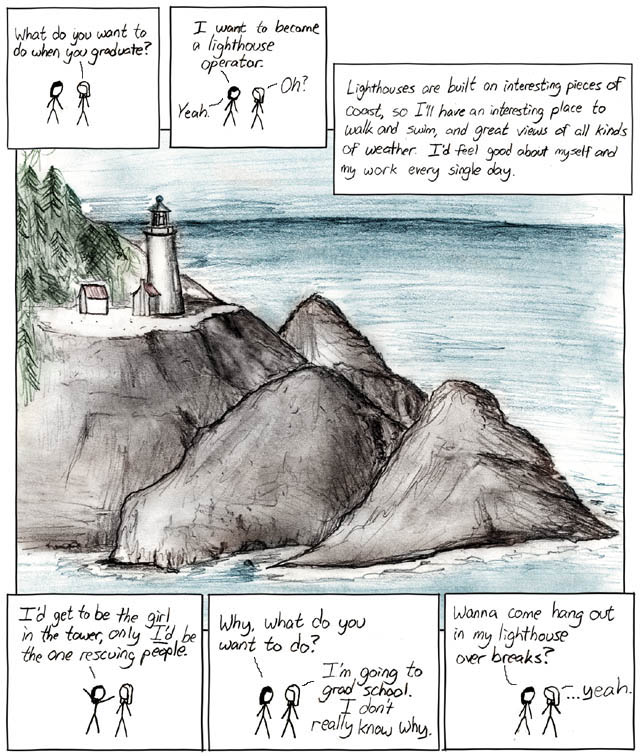
2. The Political Schmientist helped me realize what I want to do with my life.
2
I think I take things too literally sometimes. I've been walking around since I saw that picture saying, "A lighthouse operator! How do I become a lighthouse operator?" Even though I know that's not what I want: I want an interesting place to walk and swim, and a job where I feel good about myself and my work every day, and to fulfill some of my childhood fantasies about being important.

Do they even have lighthouse operators anymore?


1. Massey, Douglas and Nancy Denton. American Apartheid. Harvard University Press, 1998 (reprint of 1995, I think).
2. "xkcd - A webcomic of romance, sarcasm, math, and language." I haven't looked at the rest of it, but, um, YES.

May 14, 2007

another new thing that's just not that new

Apparently a number of people, including some Planned Parenthood volunteers, are concerned about the moral ramifications of using genetic testing to decide whether to have an abortion. Normally I would sympathize, but several are presenting this concern as being somehow in conflict with current abortion support.

People. Say it with me. My uterus belongs to me. Your uterus belongs to you. Legally, I'm not sure there should be any other relevant statement.

Yes, morally, deciding to abort a disabled (or gay or retarded or female) kid is, well, icky. And maybe, in certain cases, wrong. Abortion is morally sticky territory, being that involves the blurring of categories like 'alive' and 'not alive.' Generally, women make serious, carefully considered decisions about their personal, individual situations, which they know much much better than anyone else.

As a consequence, no law ever applies well in these situations. Outlaw abortion (or any type of abortion) and you end up with situations where someone is trying to figure out when a health exemption turns into a life exemption. Ridiculous if it weren't so awful.

For many pro-choicers, this is where it ends, and I think this focus on the legalism doesn't give a clear picture of how abortion actually happens in the real world. Worse, it obscures the other side of choice, which is the choice to have a child and have the resources to raise it. That type of choice is often less important for middle+ class (often white) feminists, and a huge deal for women of color and poor women. White feminists need to be on that shit, because it is also choice, and it is also a way in which women find their reproductive options limited and constrained by state action. And it will reduce the number of abortions: the world's lowest abortion rates are in countries (Scandinavia, the Netherlands) with easy access to abortion and contraception and a solid social safety net. Reducing abortion isn't the point, though: the point is to honor and expand people's choices.

This is the same schema that ought to be applied to genetic testing. Abortion should still be legal for any reason, but we should be working to make this a friendlier world for kids with Down syndrome or other disabilities or, hell, kids. Because outlawing some reasons to have abortion and keeping others will be a disastrous muddle; but helping people know what their options are and have more and better options? and being nicer to kids? Not problematic. People seem to have trouble understanding that not everything icky needs to be illegal. I mean really, if we're going to go that route, we might as well make canned clam sauce illegal.

May 13, 2007

traditional nuclear family

The cast
The Mathemagician - male, 26, math tutor
Deb the Dramaturg - female, 24?, underemployed dramaturg (duh)
The Hipsterest Grad Student (Pterest, with a silent p) - male, 23?, anthro grad student at the local Ivy
Mech - Deb's [male] Israeli partner, 30-something, interested in Judaism, landscaping, and sex education
The Gardener - my girlfriend, currently an apprentice at a rad farm in the suburbs
Me - female, 25, math teacher in hell


The back-story
Deb and the Mathemagician are the lesbian moms. Pterest is the adolescent son. I'm the sperm donor dad. Gardener is my gay male partner, and she and I are supposed to be positive male role models for Pterest, but are always falling down on the job. Gardener in particular is a deadbeat, says Deb, because when she's around she makes cake and indulges us all, then takes off on her next adventure when she feels like it. "Are you going to teach Pterest that people just leave??"

The situation
Pterest asks for advice about using some canned clam sauce on pasta. I say gross. We all get into a big [fake] argument about who's allowing him to eat what and how the moms indulge him too much and why aren't the Gardener and I better role models and why wasn't Pterest helping us clean the house anyway? Deb says, "I'm going out with my other partners now, and so is Mathemagician. You have to take care of our son."

This is what passes for theater around here.

May 11, 2007

in case you were wondering

Dear Clyde,
Thanks for your affection. However, when I leave my room in the morning, what I really want is to go to the bathroom in peace. I don't lock the door because it doesn't have a lock, not because I want you to come in and rub your head against my knee. Also, could you start getting out of my way when it's dark? I stepped on you three times yesterday. I'll try to be more careful, but you're the one with the night vision!
Your cat-mom

Dear 1st and 2nd period class,
I'm sorry I'm so grumpy. I really, really am. You all are great, and have learned vast amounts about exponential functions this week. I did notice.
Your Algebra II teacher

Dear 2nd period boys,
You guys need to shut up. Or stop coming to class, either way.
Same

Dear 9th-grade boys,
I am so impressed with your turn-around the last two weeks. One of you got a 98 for the week - I think it's your first passing weekly grade, and your project looks awesome. It's really cute when you come in during 1st period to get the previous day's homework. Another of you just got into Upward Bound, which is one of the few programs related to the public schools that I can recommend without reservation. I'm so glad that I stuck around that day and was in the room when the coordinating teacher told you the paperwork was too late: another teacher and I ended up finagling you a second (third? fourth?) chance. I fully believe that you and all my other 9th grade boys will escape the sad fates of my 11th graders, become brilliantly successful, and save the world.
Your transitional math teacher

Dear English teacher across the hall,
Jesus H. Christ, please stop the gay-bashing.
Your semi-closeted co-worker

Dear student's older sister,
Fuck you. Ok, also: when your brother gets suspended for threatening to punch me, it's not helpful for your mom to call me up, tell me what a horrible teacher I am, then put you on the phone. Furthermore, screaming at me to tell you my room number will not make me give it to you. And you know what's not smart? Calling me back after I hang up and leaving a lengthy, profane message in which you identify yourself and threaten to kill me. That's called evidence.
Fuck you.

Dear 911 operators,
I've called you more in 2007 than in the rest of my life combined. Thanks for not making me feel stupid when I call and it's not a life-threatening emergency requiring immediate response. I sincerely hope to go back to my normal level of calling, though I understand that part of the increase is that I now know to call 911 when there's a traffic signal out at a busy intersection.
That woman you just talked to

Dear friends,
When you read this, please remember that the good things do exist. I sincerely doubt that the crazy sister is serious. I called the police anyway. They're sending a car out. I'm taking care of myself. Also, just fyi, the adrenaline rush of listening to that voice mail is crazy. However, I still think it's safe to go to school on Monday, and I promise that my personal safety is important. I also want you to know that until 5 pm, today was pretty good. Some kids learned some stuff.
North

May 7, 2007

show me what you got

One of the many pleasures of Lil' Mama's Lip Gloss is the clarity with which it summarizes a particular 3rd Wave narrative arc: lack of confidence solved by greater beauty, life revolutionized, goals accomplished, but of course, "it wasn't the lip gloss, it was you all along." Empowerful lip gloss.


Other pleasures: displays of talent from other dancers, including the boy who tears his glasses off. The ambiguously middle-school setting, complete with lunch trays, old-school iMacs, double-Dutch, and slightly dorky clothes. Lil' Mama's surprising butchness: rapping, the hat, grabbing her crotch. The universal technology, including video-shopped pin with Lil' Mama performing on it, videos playing on iMacs, even the flip book.

Also the beat.

May 1, 2007

we are the only people who have ever lived

"I was going to write about [whatever]" is probably the most over-used intro ever, at least out here on the internet. However. I've been meaning to write about a Times article from April 10 since April 10. Unlike many such inclinations, this one's stuck with me, like a burr that you can't get out of your bootlaces. Thus, today's expression of irritation.

The article in question is about sexual desire, and, specifically, about what determines the gender of the people you're attracted to. Ok. Let me just state, for the record, that gender doesn't affect attraction for me. At least not mostly. Gender presentation does, a little bit, but that's a story for a different time. So when the article suggests that desire may be pretty fluid for women, at least in terms of what our brains do, that rings kind of true. Anyway, I know a lot of women who are kind of flexible, and very few men (though I do know some). Not that that's worth mentioning in the newspaper.

But people! Come on! To argue that men have a fixed sexual orientation that cannot be changed, and that whatever the level of same-sex male desire is, it's fixed? That's just irresponsible ahistoricity. There are a lot of societies other than the modern-day US where men had sex with men at certain times, and with women at other times. See ancient Greece. Also Elizabethan England. Also present-day Sri Lanka, where my housemate says it's pretty accepted that young men will have all sorts of same-sex encounters, because female virginity at marriage is highly valued. Also the down-low cultures in the US. These guys are getting it up for men and for women, and actively choosing to have both kinds of relationships. I'm sure some of it is about limited options (e.g. jail and the British Navy, which was once said to run on rum, sodomy, and the lash), but it happens all over the place. Claiming that "Sexual orientation, at least for men, seems to be settled before birth" ignores the fact that 'sexual orientation' is a concept of the last 200 years at the absolute most. Before that, you did this, and you did that, but it wasn't about identity, and it might change. Unless the professors quoted in the article seriously believe that men in western/European/US culture have actually evolved genetic differences from their ancestors within the last 200 years (and while the Y chromosome evolves faster than the X, 200 years?!), they're looking directly in front of their noses and nowhere else.

Not that I was expecting that they would. Just, you know. That paragraph above? That's introductory stuff. Seems like you might could think of considering it if you're a professor and all.

April 22, 2007

dinner at Loud

Dinner: Whole-grain spelt crepes with Oley Valley oyster and shiitake mushrooms and Mother Earth yellow oyster mushrooms, local nettles, and Valley Shepherd cave-aged sheep's-milk cheese.

Intermission: summer fruit sauce made with maple and rose-geranium sugars.

Dessert: Bassett's coffee ice cream with Nutella.

Wine: Bonny Doon Pacific Rim Dry Riesling.

It was even better than it sounds. And here's our scorecard:

Local (within 100 miles)
Mushrooms, nettles, rosemary, sage, onions, eggs, butter, cheese, strawberries and peaches from the freezer, maple sugar, rose geranium

Partly local (regionally produced or made by a local business from not-local ingredients)
ice cream, spelt flour

Not local
Sugar, salt, olive oil, wine, Nutella, one tablespoon of soy milk

speaking of France

Did you know that Ségoléne Royal1 isn't married? She has four children with her male life partner, and they have a civil union, but she's not legally or religiously married.

It may be hard to believe for those of us in the sex-obsessed US, but this has not been a campaign issue for her.


1. The Socialist candidate for president of France.

April 18, 2007

patriarchy at work

In honor of the Supreme Court's decision, let's all remember who was there when the 'partial-birth' abortion ban was signed.

April 17, 2007

incompetence is no barrier to achievement

Don't read the cover article of this week's NYT magazine. Or if you do, don't say I didn't warn you. To summarize: Thomas Friedman would like us all to know that he has a big dick, and it likes the environment. But not in a "sissy", "vaguely French" way. No, this is a "muscular and strategic" "Geo-Green" sort of dick that considers "the First Law of Petropolitics" in its quest to ravish the world.

Instead, you should read a review of Friedman's book. By the time the Mathemagician was done reading it to me, I was lying on my kitchen floor, convulsing with laughter, tears streaming down my cheeks, whimpering.

April 13, 2007

why hierarchy sucks

I had lots of time to think today. I spent most of it waiting 4.5 hours to talk to my principal. And what I thought about, in that time, is how extremely important it is for leaders of all sorts (principals, teachers, presidents) to be accessible. I used to be able to drop by the director's office at the outdoor ed program where I worked, and I talked to my direct boss in depth at least every other week. It was part of my job and his job, and it meant that I always knew where I stood. The other outdoor ed program was bigger, so we had forms to get signed and mandatory short check-ins every other week, but if you wanted to talk to someone they'd schedule you a time. You can have more formal systems too, like having office hours or a meeting every day or week that's reserved for employees or a secretary who'll make an appointment for you, but you gotta be able to get in touch with your boss. Especially if you're trying to set up some kind of special something for your organization that needs your boss's approval.

What does not work is asking people to stand outside your door at random times until you decide they're worth talking to.

What also does not work is telling them you'll meet with them at a specific time, then disappearing at that time with no explanation or apology.

And if you need a definition of adding insult to injury, it's having your boss finally meet with you, then interrupt the meeting every 30 seconds to talk to someone else.

I'm not saying I'm so important. But I'd feel better about my job and my work if I got treated like I mattered some. Even worse, this is moving up in the world compared to some.

April 8, 2007

time to look in the impossible places

There's a short article in the NYT magazine by Noah Feldman this week that purports to be about the lack of any political candidates with clear statements about how to get out of Iraq. While the article frames it as being about politicians' trying to negotiate conflicting electoral desires and paradigms for resolving the conflict, it's notable for what it lacks: a clear statement of the real options for dealing with Iraq. To my mind, this is because there aren't any. For most political problems (access to health care, the global AIDS crisis, global climate change, crime in the inner city, equal rights for queer people) there's some action the government should take, even if it's not enough to fully solve the problem. In Iraq, all of our possible options are hopelessly compromised: whatever action the US government takes, some unacceptable consequence will almost certainly ensue. Notably, these unacceptable consequences are unacceptable to Iraqis, Americans, politicians, academics, and the world community, meaning that politicians literally have nowhere to go to find a reasonable strategy for resolving US involvement in Iraq.

The conclusion of US involvement in Iraq will only happen once we accept one of the unacceptable consequences. Thus, while the article sets up the problem as one of political will, it's in fact a problem of available options. We're going to have to accept at least one, and maybe more, of the following consequences in order for the current unproductive muddle to end.

1. Genocidal civil war, coupled with a major refugee crisis, destabilization of the region as the various surrounding countries jockey for influence, massive loss of face for the US, and loss of access to Iraq's oil production. I should say, more of these things than we have now. This is the likely consequence of withdrawing all US troops on the timelines set out by the House and Senate bills. No one is willing to accept this consequence explicitly: it's a humanitarian and international-relations disaster. It is, however, very likely to be the consequence we accept by default.

2. A major increase in US troop commitment. Not a surge, not a small escalation, but overwhelming force. Despite Iraqi hostility to the US presence, I think a massive escalation that actually established security and helped rebuild infrastructure might be welcome. You'd need a draft and a complete change in the US political scene. The US wouldn't lose quite as much face, but Iraq would become our major effort for the next five or so years. Say goodbye to any other policy priorities that might compete with the war effort. Also to your male relatives.

3. Giving other countries in the Middle East a lot of say in Iraq. It might work to have a federally partitioned Iraq - something along the lines of the former Yugoslavia - with large protector states for each section. There's precedent for major powers coming together to split up powerless states, and while I don't think it's so great, it might be better than door #1. It might also be possible just to have Saudi and Iranian involvement and protection without dividing up in the country. The downside risk is that, like in Yugoslavia, lots of people might end up having to leave their homes as the ethnic and religious borders got defined, and there would almost certainly be some serious violence and brutality. The US would have to explicitly provide Iran with influence in Shiite Iraq, and the US, Iran, and Saudi Arabia would probably have to be the minimal guarantors of the peace. You'd also need assent from Syria, Jordan, and Turkey - Iraq's other neighbors - though Turkey is pretty likely to just accept whatever it is, since the Kurdish section along its border is relatively stable. There'd be a lot of arguing about oil and borders, Baghdad might have to be partitioned, and it has the potential to set up a major future war about oil, religion, and whatever violations of the peace are certain to happen periodically. This consequence is the least likely to happen, and is also the least defined right now. It carries enormous risks, and might be impossible anyway.

On the other hand, Juan Cole, who, as a professor of modern Middle East history, knows a smidge more than I do about these things, thinks it might work. His vision depends, though, on the US actively engaging with Iran, which is going to take a change of administration at a bare minimum.

The defining theme of these consequences is that Iraq needs some major force if we're not going through door #1. The US could provide it, or other countries could provide it, but I think we've seen that the Iraqi government is, at the moment, totally unable to provide it. Both sides of the American political fight present the canard that "The Iraqi political classes could deliver law and order and reconstruction if only they really wanted to, but their incentive to save their country is somehow reduced by the presence of the U.S.," but Feldman points out that "It is hard to overstate how absurd this view would sound to anyone who wasn’t looking for excuses to withdraw." Basically, putting total responsibility for stability and reconstruction on a brand-new government in an extremely unstable state in which being a member of the government at any level is likely to get you killed? Not reasonable. Not going to work, anyway. Choosing that means choosing door #1.

And what do I think? Well. I don't really know. But door #3 is the only one that might, possibly maybe, not be a human catastrophe. So I'll go with that.


1. The title comes from something my mom says. If you can't find your keys after you've looked in all the possible places, it's time to look in the impossible places.
2. Edited because I read Juan Cole.

best graffiti ever

On the toilet paper dispenser in the bathroom of a BP in Carlisle, PA:

I <3 buckwheat