travel plans
I'm headed to Great Smoky Mountains National Park, where I will be held incommunicado through Sunday, and thence to Des Moines, where I'll have most everything the information age can offer. Even cable!
I'm headed to Great Smoky Mountains National Park, where I will be held incommunicado through Sunday, and thence to Des Moines, where I'll have most everything the information age can offer. Even cable!
So Andrew asked why I'm supporting John Edwards, and brought up some things he's been wrestling with: electability, leadership, and policy positions. All of those things are shorthand for 15 million other things, but here's my best shot at explaining why I'm supporting Edwards. For the people who always read the last page first: it's about policy.
But first, let's talk about something else: experience. Hillary Clinton is the only Democratic front-runner with really serious Washington and policy experience, and even she has very little electoral experience - she's just an insanely savvy person who spent 8 years hearing very directly about the Washington experience of another insanely savvy person. Neither Edwards or Obama has any real experience making day to day government decisions as an executive, or moving bills through Congress in the way a president has to do to be effective. I'm concerned about that, but I'm unwilling to vote for Clinton over it. If Bill Richardson's campaign gets any momentum, I might be interested, but let's put that aside for now.
On to electability. I don't really trust myself to predict who's electable in a general election, and I think that efforts to predict electability have screwed the Democrats six ways from Sunday. Kerry? Gore? Not the world's most electable people (in that Kerry wasn't elected) - yet they were chosen specifically for their electability. So I'm not really playing with that right now. I think Clinton has the most serious electability problem of the three major candidates: the American public is pretty damn sexist, plus she's a very polarizing figure, plus she's kind of varnished, which hasn't been going over well lately. On the other hand, have I mentioned how savvy she and her husband are? Obama's race will likely play against him, but I don't feel completely certain of it. Edwards is doing the worst in the head-to-head general election polls (though Dems reliably beat Reps), but I have some questions about whether the sexism/racism cards would affect Obama and Clinton differently in a polling booth rather than a phone call. I got kind of sick of spinning around in circles about this, so I decided to give up. Also, I think focusing on electability encourages a kind of content-free, passion-free politics that is one of the major problems of the Democratic party.
Leadership: I'm going to talk about race and gender here, since I already talked about my concerns about experience. I feel like I should be supporting Obama or Clinton specifically because I am a feminist and anti-racist. Obama is also super-inspiring for many people, which I think would be great in a president (and speaks some to electability). But ultimately,
It's all about policy. Specifically health, environmental, and economic policies, and specifically because there's pretty good evidence that presidential candidates do what they say they're going to do a lot of the time. Edwards's health care policy is really smart, and I think it could get passed and would work. Universal health care is one of those things that's becoming a middle-class issue in a way that means it'll probably get addressed within the next 5 years or so, and I think it matters a lot who the president is then. Clinton won't put her plan out there, and Obama's is pretty complicated, and I think would have a lot fewer cost-saving effects than the Edwards plan because it doesn't expand the pool of insured people as much, thus keeping risk and premiums higher than they ought to be. Obama's policies over-all are fairly piece-meal: his energy policy is like that as well.
Finally, Edwards has put economic inequality on the table in a way that I think is really, really important.
I would say more but I'm incredibly hungry and I'm leaving town on Sunday. More comparative policy analysis coming in two weeks or so.
(Julie and Andrew: big fat congratulations!)
The Democratic candidates are going to have a gay debate. I mean a debate about gay stuff where Melissa Etheridge and the head of HRC ask them questions. Does the debate itself have a sexual preference? How would we ever know?
I am really really excited about this for some reason. Maybe because I have some hopes it'll cut through some of the not-answering-questions-for-real bullshit that happens a lot with the Democrats. Except for Elizabeth Edwards, of course, but unfortunately she's not running for president.
Shorter Bush to Congress: lalalalalala I can't heeeeeeaaaaar you.
Harriet Miers isn't even going to show up. Is there anyone who seriously believes he isn't hiding something pretty damn big?
In other news, the man's approval rating dropped to 29%. How low does it have to go before we can get impeachment?
For serious, call your representative. It is your representative's JOB right now to be submitting impeachment motions. Instructions given here.
p.s. most duh headline ever: White House Is Accused of Putting Politics Over Science.
There's an article in Psychology Today titled Ten Politically Incorrect Truths About Human Nature. Echidne of the Snakes spent some time doing a point by point refutation, which I suggest you read if you're interested in that sort of thing. Basically, the article itself is a particularly genius example of how Evolutionary Psychology as most people use the term is basically a collection of speculation about the lives of early humans, most of which gets used to justify sexism and crappy appearance politics. Refuting it requires slightly less work than shooting fish in a barrel. You don't even need a gun!
My sister studied bioanthropology (basically, the study of humans using biology, which includes quite a bit of evo-psych) in college, and I remember vividly two conversations about it that I had with her. When she was a sophomore and deciding to study bioanth, she argued that I was just wrong not to accept that differences between men and women were biologically based, and that my feminism was blinding me to the strong evidence for it. Two years later, as a senior, she called me up while I was driving through Utah and asked what she should do. She needed to write a senior paper - like a small thesis - to get honors, which she very much wanted, but she felt like she couldn't in conscience write a paper on any of the bioanth subjects she'd studied because the standards of evidence were so unutterably lame and unconvincing. Two years of study brought her to the conclusion that even at a fancy-pants research university, most evolutionary psychology is a collection of speculation about the lives of early humans.
I have a similar problem with a great deal of political theory, including all social contract theory. These theories rely on some kind of imagined history of early humans: life was "solitary, poor, nasty, brutish, and short," then we all got together, signed the social contract, and turned our power over to the state. Hobbes is one of the most honest about this kind of thing (he doesn't make up rights without explaining where they come from) but still. Wasn't it great when we all signed the social contract? What a great party! No wait, no one was there. IT NEVER HAPPENED. (One of the things I like about Aristotelian political theory is that, while there's a theory of human nature, there's no just-so story about how we came to be this way.)
We know a little more about the lives of early humans in a factual sense than we used to, but we still have essentially zip about social structure. Among other things, it's pretty unreasonable to argue that social evolution just stopped at some point (which is what you have to say for evo-psych to still be relevant, or to use modern hunter-gatherers to learn about ancient hunter-gatherers), when we have very clear evidence that lactose tolerance evolved in some places as recently as 3,000 years ago. Humans continue, however, to be very good at coming up with reasons to justify whatever it is we want to justify right now, including rights, greed, censorship, free speech, monogamy, polygamy, etc.
Evolutionary psychology and political theory share one gigantic missed opportunity. Yes, it would be very very interesting to know more about how human brains really work and have evolved, and yes, it would be very very interesting to know how the social structure of early human societies developed, and think about what implications those have for our ideas about politics and community. Aristotle assumes that humans are by nature social - he doesn't even really imagine an isolated state of being human - and that seems likely to have some foundation (unlike, for example, his transparently bad justification for slavery). There's some serious work to be done matching up science and archeology about early humans with theories about human nature and society. But political theorists (who have some excuse, since they're not scientists or historians) and evolutionary psychologists (who have none, since they claim to be both) have done a pretty dreadful job of it. Too bad!
I drank some very good peach beer, ate some very good Mexican food (restaurant review coming soon), had Queen Anne cherry sorbetto with dark chocolate gelato (Capogiro: still amazing), took the famous outlaw cattens to their temporary home with a very nice woman and a yappy dog. All this with the Political Schmientist. Then I went to the beach! A Feral Hat reunited, plus some excellent people who are and are not getting married. There aren't enough exclamation points to tell you how I feel about boogie boards! Why don't I live at the beach? Then we spent an hour between exits 113 and 120 on the Garden State Parkway and was late to dinner with my parents. And then my parents were in the LA Times, and then there were various not very surprising revelations and some excellent talk at hat-brunch. I had dinner with a food writer and his wife and aforementioned parents. It's hot. The diner for lunch with Fire Boss and a non-practicing Ph.D. with crazy eyelashes decided we didn't need pie. Got described as 'well-behaved' for the first two times in my life.
Then I drove home, read for a while, ate dinner. Listened to some awesome music, if I do say so myself. Drank another peach beer in the shower. Now I will watch TV.
When will someone make Hotel Yorba into a movie? I want it now!
Look. It's the 4th of July. This is a great time to love your country, and celebrate the noble words of the noble documents that started the whole thing. But it's an even better time to talk about how, as people who care what the hell is happening in this country, we have work to do. The gap between the lovely words and the violent and unethical actions should be our concern today. (All links below go to the relevant outrage.)
The history of the present [President of the United States] is a history of repeated injuries and usurpations, all having in direct object the establishment of an absolute Tyranny over these States. To prove this, let facts be submitted to a candid world:
--
He has refused his Assent to Laws, the most wholesome and necessary for the public good.
He has forbidden his Governors to pass Laws of immediate and pressing importance, unless suspended in their operation till his Assent should be obtained; and when so suspended, he has utterly neglected to attend to them.
--
He has called together [judicial] bodies at places unusual, uncomfortable, and distant from the depository of their public Records, for the sole purpose of fatiguing them into compliance with his measures.
--
He has refused for a long time, after such dissolutions, to cause others to be elected.
--
He has made Judges dependent on his Will alone, for the tenure of their offices, and the amount and payment of their salaries.
--
He has affected to render the Military independent of and superior to the Civil power.
--
For protecting them, by a mock Trial, from punishment for any Murders which they should commit on the Inhabitants of these States.
--
For depriving us in many cases, of the benefits of Trial by Jury:
--
For transporting us beyond Seas to be tried for pretended offences
--
For taking away our Charters, abolishing our most valuable Laws, and altering fundamentally the Forms of our Governments:
--
In every stage of these Oppressions We have Petitioned for Redress in the most humble terms: Our repeated Petitions have been answered only by repeated injury. A Prince whose character is thus marked by every act which may define a Tyrant, is unfit to be the ruler of a free people.
Here's how we do it.
1. Call your Representative. The House needs a simple majority to pass articles of impeachment, and there's a Democratic majority right now. Call your Republican Representative too. Tell your Representative that by not calling for impeachment, he or she is failing to represent you and failing to support and defend the US Constitution, which they swear to do when they take the Oath of Office. Contact information is at http://www.house.gov/writerep/.
2. Call your Senator. Contact information is at http://www.senate.gov/general/contact_information/senators_cfm.cfm. The Senate would have to convict, but you're mostly calling to encourage your Senator to support articles of impeachment.
3. Still got energy? Write your local newspaper. Tips for getting in: make it short, find an angle other people aren't using (e.g. a specific reason for Bush to be impeached, not an overview of his crimes).
4. Send this to everyone you know. Better yet, write something to send to everyone you know. Your parents, your friends, your relatives you haven't seen in five years, everyone.
5. Go eat some sweet corn.
Happy 4th of July. Impeach Bush.
I work out (when I work out) at the university gym, which is mostly pretty pleasant. But dude. I mean you, the one in the muscles. The one grunting. The one who drops his weights after every single set. Say it with me: If you can't put it down carefully, don't pick it up. No, again: If you can't put it down carefully, DON'T PICK IT UP.1
Every time you pick up a weight, you know you're going to have to put it down. Every single time. You can apparently gauge your own strength well enough to always pick up something you can't put down, so change your calculations. It's loud, it's distracting, maybe someday you're going to drop it on your toe or hit the mirror or my leg. If you can't put it down carefully, don't pick it up.
Oh, and stop with the grunting already. Nobody wants to hear that.
All year, there was a group of five or ten juniors who just wouldn't do any work. No homework, no classwork, no tests, no nothing. Eventually I figured out why: they'd made a basically rational calculation that it would be less work to pass summer school than to pass my class. 20 days, easy tests, low standards. It drove me crazy, because they were right; but because they didn't care about my class at all, they had no incentive to sit down and shut up or learn anything or care about a goddamn thing I said.
Today, eleven days after the end of the school year, I got a call from the person who's teaching Algebra II at my high school this summer. He's in the same program I'm in, and he's planning to make them work. This ain't your usual summer school.
Revenge, mothafuckas!
A partial list of selective pressures that modern medicine has made irrelevant to humans in the developed world (and the technology that fixes them):
Good eyesight (glasses, contacts, LASIK)
Easy childbirth (C-section)
To some extent, high sperm count (fertility treatments)
Lactose tolerance (lactaid, abundant and varied food)
Resistance to smallpox, measles mumps rubella, tetanus, diptheria, pertussis, chickenpox, polio, and meningitis (childhood vaccinations)
Resistance to black plague, streptococcus, cholera, infant diarrhea (antibiotics and water treatment)
Is this relevant information? If so, how and why? If not, why not?
Rebecca Charles, owner of Pearl Oyster Bar, where I have never eaten, is suing someone who runs a similar restaurant on the grounds that he is taking her intellectual property. Yeah, he was her sous chef. But gray wainscoting is her intellectual property? Oyster crackers at a seafood restaurant are her intellectual property? Puh-leeze.
This just displays why the whole idea that intellectual property is somehow the same as physical property is silly. There are two macro-level reasons to protect intellectual property: so people have an incentive to invent and design and come up with cool stuff because they'll be able to make money off it, and because it's unfair when someone steals your idea and makes money off it. Unfortunately, that whole incentive thing is kind of getting lost and law is getting reshaped to value only the second one.
This is really what the internet radio copyright issue was about: internet radio stations, most of which make little money, are being required to pay SoundExchange, the royalty organization, a lot more than they previously had to. Worse, their decision is retroactive, which will probably put some of them out of business. This unambiguously reduces the flow of ideas and music and general awesomeness, and is opposed by many smaller artists, who get a lot more exposure through internet radio than regular radio. Similarly, early hip-hop artists could do crazy awesome sampling in which they used little bits of dozens or hundreds or thousands of songs to make a track or an album, which is instrumental to Public Enemy's early sound. In 1991, copyright restrictions tightened; in 2004 the 6th Circuit ruled that NWA sampling an unrecognizable bit of George Clinton constituted copyright infringement. Legal radio play for that kind of sound is over. Now if someone is going to sample another song, they're going to make damn sure they get what they pay thousands of dollars for, so you actually get a less creative sound from sampling as artists play bigger, less altered parts of the sample.
Enforcing the "it's unfair for people to steal your stuff" goal of intellectual property is particularly dumb because it's not like it hurts George Clinton to have an unrecognizable, heavily altered 3-note guitar riff show up in an NWA song. That's very clearly new innovation, new art, the kind of thing that should be a major goal of intellectual property laws, that it makes me a little despairing about the stupidity of the system. It also shows up why it's so dumb to treat intellectual property like an exact analogue of physical property: when someone 'steals' your intellectual property, you can still use it. If you take my electric pencil sharpener, I can't use it anymore. Intellectual property law needs to differentiate more clearly between situations where someone takes your intellectual property and you lose some important use of it (e.g. selling bootleg DVDs) and situations where something you made becomes inspiration (restaurants, books, musicians do this all the time) or part of a new art form in a way that doesn't limit your use (sampling).
By these standards, I think it's pretty clear that Ed's Lobster Bar gets to have gray wainscoting and a marble bar. And he may win, but I wish people would stop with the rhetorical equating of intellectual and physical property already. Especially since just about everything owes some kind of intellectual debt to someone, including all those musicians SoundExchange alleges to protect, making it almost impossible to tell where these lines should be drawn. Are we now going to prosecute all the Beatles rip-off bands? Every angsty teen-age girl who covers an Ani song at an open mike night? There's a telling moment in the NYT article in which Rebecca Charles, whose number one complaint about Ed McFarland's restaurant is the Caesar salad, whose recipe she says he stole, describes where her recipe came from: "She learned it from her mother, who extracted it decades ago from the chef at a long-gone Los Angeles restaurant." Does she owe her mother royalties? Does her mother owe the chef? Where is this silliness going to stop?
In the Public Enemy interview linked above, Chuck D gets asked what he thinks about fans remixing his tracks without permission. He says, "I think my feelings are obvious. I think it's great."
So. Everyone hates Ann Coulter. Too bad most of her critics aren't as classy or resolute as Elizabeth Edwards,1 who called in to Hardball to "ask her politely to stop the personal attacks," which thus far have consisted of calling John Edwards a faggot, wishing "he had been killed in a terrorist assassination plot," and claiming (in a column!) that he drove around with a bumper sticker that said "Ask me about my son's death in a horrific car accident." Seeing Coulter's response to Elizabeth Edwards asking her repeatedly and politely to stop saying horrible things about her family blew my mind. Coulter's responses were basically 100% lies, irrelevant, or ad hominem attacks: "I didn’t say anything about him," "I don't have enough money" to hang out with the same people as the Edwards family, "Why isn't John Edwards making this call?", "The wife of a presidential candidate is asking me to stop speaking."
I mean seriously, why is she getting invited on Hardball? Or anything? She's famous for being mean, and I know a lot of funnier, smarter, more interesting mean people I could recommend if Chris Matthews is fresh out of ideas.
Elizabeth Edwards's response was something you recognize if you're from the Midwest, or apparently the South: the polite, mild-mannered lady who will not let you walk all over her and will hold her line no matter what.2 Edwards just kept saying that Coulter's nasty personal attacks "are not legitimate political dialogue," "debases political dialogue," etc. She's a force to be reckoned with, even if she's being resolutely polite. There are a number of people like that among my parents' friends, but I don't think I've ever seen it done that well. Coulter's response was all spluttering and vitriol, and the contrast could not have been more clear.
Unfortunately, the people who commented on that Think Progress video and transcript were neither so restrained nor so effective. There's plenty to hate about Ann Coulter, but insinuating that she's transgender or talking about her "deteriorated face" or calling her a coke whore - these are ad hominem attacks that mimic the worst of Coulter's own rhetoric, not to mention being horrifyingly anti-feminist. I feel like I need to take a shower just reading the thread. Remember, the problem isn't what she looks like, it's what she says and how she says it. The way to fight her is to pull an Elizabeth Edwards: pointedly courteous, consistent, honest, clear, letting Ann Coulter make herself look foolish.
It's aged in bourbon casks.
In other news of summer decadence, I've been to Capogiro twice in the last two days. Holy hell, that place is amazing.
Monday: strawberries and cream gelato with cucumber sorbetto; the person I was with had Charentais melon and grape sorbetto.
Tuesday: rhubarb sorbetto with rosemary honey goat milk gelato, which, whoa; the person I was with (someone different) had gooseberry and lychee.
Who wants to go with me tonight?
I've read something like 5 books that really changed something about my life or my thinking. I've read them all since I turned 20, and together they make up a good part of how I think about the world. They were significant not because they radically changed everything about how I thought, but because they consolidated and added to some understandings I already had, and got me started thinking in new directions.
One of them is The Omnivore's Dilemma, which has the disadvantage of being pretty trendy right now. But let me tell you why you should read it anyway. Mostly because it's awesome, and a little because it's about to come out in paperback.
It's subtitled "A Natural History of Four Meals." Michael Pollan - the author of basically all the local food articles for the NYT magazine in the last few years - investigated four ways of getting and making food, then cooked a meal from each. Significantly, he originally planned to make it three: industrial (meal at McDonalds), organic (Whole Foods, etc), and wild (hunting and foraging the ingredients). As he got deeper into the research about organic farming, he realized that enormous, single-crop organic operations like Earthbound Farms (proud producers of that fancy lettuce mix) are wildly different from small local farms that integrate different kinds of plants and animals.
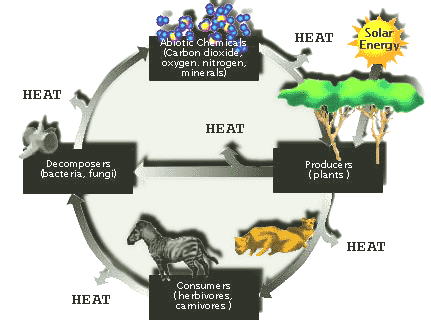
That tiny insight is the seed of what is so important to me about this book: the recognition of farms as ecosystems. They've got plants making sugar from the sun, animals eating plants (insect pests or farm animals), animals eating each other (predators of insect pests), nutrient cycling, all the features of any ecosystem. Once I started to see a farm as an ecosystem - a small one, dependent on the other systems around it, but an ecosystem nevertheless - the whole way I thought about responsible farming changed. I'd been very focused on an idea about how much absolute energy it took to produce a food item, which led me to be a vegetarian for about 10 years. Reading The Omnivore's Dilemma shifted my focus to trying to eat in a way that contributed to the existence of sustainable ecosystems.
Sustainable ecosystems are sustainable by virtue of the fact that they can keep going. Whatever they are doing doesn't hit a dead end or run out of steam. To do that in the temperate zones of the US often focuses around soil: keeping erosion pretty minimal, keeping a fairly closed loop in which nutrients leave the soil, go into plants, and somehow get back to the soil. Without the closed loop, the value of the soil erodes and the land needs external fertilizers to be usable; farmers end up dependent on expensive inputs, so they have to maximize production to make it, so they deplete the soil, so they need more inputs. This isn't a sustainable system. You need to do real nutrient cycling. It turns out that animals are by far the best way to do this, because they eat plants and parts of plants and then poop out easily composted fertilizer. Do this right and you can actually restore a piece of land to health by farming it, as Pollan describes Joel Salatin doing on Polyface Farm. This makes a lot of sense when you remember that this continent was managed for food production by Native Americans even when they weren't using agriculture.
This took me in two directions. On a practical level, I decided I wanted to support healthy farm ecosystems. Since farmers need animals to do nutrient cycling, that means supporting small-scale animal production. It would be nice to say that this is why I originally started eating meat again. Actually, I was sleeping outside 150 nights a year and was just cold all the time. Bacon? It'll keep you warm at night. I kept eating meat after I gave up my wilderness job because I'd rather get my protein in a way that helps small-scale farmers have healthy ecosystem than eat industrial soy, which is planted in monocrops that are ruining the unbelievably fertile prairie ecology of the Midwest. I see my food choices differently: partly because of The Omnivore's Dilemma, also partly because of the Gardener and my parents. Wendell Berry said "eating is an agricultural act." Eating is also an ecological act, because farming is an ecological act.1
The other, maybe more interesting, direction my mind went wandering while I read The Omnivore's Dilemma was to thinking about the sort of complexity that is at (maybe beyond) the limit of human understanding. In one of his articles, Pollan lists the known antioxidant compounds in a sprig of thyme: it goes on for a full paragraph. In the book, he describes the NPK revolution, in which agronomists believed they had discovered the only nutrients plants needed: nitrogen, phosphorus, and potassium. Feeding plants only these three things is roughly equivalent to feeding a human a blend of pure fat, carbohydrate, and protein. Even if you eat the right proportions, you're missing tons of minerals and vitamins and compounds we know almost nothing about right now. Also interesting is that the meat of a grass-fed cow is nutritionally very different from the meat of a corn-fed cow, and has meaningfully different effects on your body; there are also differences among vegetables grown in different circumstances (unsurprisingly, organic vegetables have more and more complex nutrients).
It reminded me of a conventional banana plantation I visited during a study abroad program in Costa Rica. The banana plants were tied to each other: bananas aren't actually trees, but a type of large herbaceous plant; the fruits of commercial banana plants are so large that they will actually knock the plant over if it isn't tied to something. The dirt was gray and clay-ey and looked dead. Nothing grew on the dirt in between the trees. The plantation was constantly sprayed with pesticides. I remember it as a place where the banishment of other life forms made it feel like a wasteland. An organic banana plantation just felt like a farm. Birds, insects, ground cover - stuff lived there.
Humans now know that we need biological complexity much more strongly than we can describe how it benefits us or even how it works at all. We're using very blunt tools to deal with a biological world that is totally awesomely complicated. In this context, some of our best resources are intuition and tradition. I find it paradoxically wonderful is that we often can't pinpoint why something works using science, because there are too many variables; but traditional methods of farming and eating often turn out, when analyzed, to work for scientific, provable, identifiable reasons. Sometimes not, like slash-and-burn, but even for slash-and-burn agriculture we can understand why it doesn't work: it's based on the assumption that more land will always be available. Partly because of The Omnivore's Dilemma, I'm really interested in understanding these valuable mental shortcuts we all seem to have.
Did I mention that you should read that book?
In college I drank terrible alcohol, because it was free. I also developed a working philosophy that the crappiest beer I'd pay for was Yuengling Lager. Which is not that crappy, but pretty cheap, and thus holds a special place in the heart of any Philadelphian. If you want to order it at a bar, you ask for lager. No specification required.
The other beer we love in this city is Yards. It's "the oldest and only surviving brewery within city limits," and it's definitely one of those hipster revival kinds of deals. Whether you drink Yards or Yuengling might say something - or might not - about which part of Philadelphia you identify with. Yards is a little more expensive, more in the price range of something like Magic Hat - maybe not quite as exciting a brewery as Dogfish Head, which describes itself as "off-centered ales, for off-centered people" and is probably my favorite local brewery. But Yards gets the love, because it's from here, and because the Yards Variety Pack? It's exactly what you want for a party.
I went to the beer store today because we're having a party, and what do you know? Yards is no longer in the same price range as Magic Hat or Dogfish Head. It's a lot cheaper. Not as cheap as Yuengling, but Yards is now cheaper than Blue Moon. Yards is now cheaper than Corona. I asked the guy at the store about it, and he says Yards has started doing their own distribution locally. No distributor knocks off $4 a case.
People, this is fucking genius.
It's the last day of the school year. Thursday, the custodian on my hall asked why I work here. Why didn't I go somewhere else?
I started teaching because of this girl, call her Anastasia. It starts before that, of course, with the many accidents that got me leading wilderness courses in Philadelphia. But the teaching part, that's because of Stasia. Stasia is awesome. She's smart, she's motivated, she's responsible, she's got great interpersonal skills. Once, I saw her pull a kid aside at the beginning of a trip and calmly, politely ask him to stop making sexist comments because it made her angry. He stopped. Another time, she was the leader for the day on a trip. She was uncomfortable because she'd have to motivate people in the morning and she thought she'd be scattered if she was trying to pack herself. She asked me to wake her up half an hour early that morning. So when Stasia needed someone to tutor her for the SATs, of course I said yes.
She couldn't add fractions. Or multiply or divide or define them. She said the last time she'd learned any math was 8th grade. She had As and Bs in her math classes.
It still makes me angry to think about it, though I understand it a lot better now and I'm not as angry at her teachers as I was. But I started teaching in order to do right by Stasia and kids like her, kids who just need the chance to learn something, who are self-motivated enough to really do well but aren't getting what they need. That's why I stayed this year, even when it was hell. It's someone else this year, of course - a few someone elses, not many - and while there are a lot of kids I didn't do right by, I do think in the end I did right by Stasia. If she'd been in my class, she would know how to add fractions by now, and a hell of a lot more. And that's something. Not everything, but something.
I think my favorite ridiculous NYT article of the last month is the one about how important it is to save money. Anyone who's looked at compounding recently knows that time makes a huge difference - that's not what's ridiculous.1 But check out this question:
"How would you like to try to live on $40,000 a year in Washington or San Francisco?"
Once you regain your composure, let's talk about reality. Not even the reality of poverty - don't forget that the poverty line for an individual is $9,800, and that to be eligible for food stamps you can't make more than $12,744 a year - but the reality of college-educated, middle-class identified single (or married-no-kids) people like the ones that article speaks to. I live in Philadelphia - much cheaper than Washington or SF (where I've lived briefly), certainly much cheaper than NY - so my qualifications are somewhat limited. Except check it out: I lived on $11,000 for a year here, and I know people who've lived on less. That is less than a third of what the author describes: Washington, NYC, and SF are at most twice as expensive as Philly, and then only for housing. Food costs in the Bay Area are way less than anywhere on this coast. And I do not want to do it again, but I had a CSA share and I went out for brunch and I lived in a sweet apartment that I liked (and where the pipes froze every winter), and the next year I made about $15,000 and that was fine. I didn't pay for health insurance, and there my class status comes into play: my parents could afford to pay for my health insurance so they wouldn't end up bailing me out if I got seriously injured. But $40,000 a year? And you're wondering if you have enough to save a little? You need a reality check. 2
Some caveats. Abramorous pointed out, in heated discussion with Deb and me, that I didn't work in the business world, and that people who do so have expenses that I didn't. Clothes, meals out that are optional but will substantially benefit your career, haircuts, whatever. And that's true, but he and I disagree on how optional those things are. I work with people who make that much now, and let me tell you, people spend a lot of money on things they don't need. I know what most of those things cost, and really? $40,000 buys a lot of fancy haircuts. He also pointed out that before judging all these people so harshly, we should consider that some of them may have major expenses like student loans or health issues that aren't just for entertainment value. So, yes. If you make $40,000 and need to see a therapist or pay off student loans or travel cross-country to see your ailing family members, no judgment that the money's tight. But that's not the situation Damon Darlin envisions.
Fundamentally, this article reveals the class status of the people Darlin is writing for. The audience of the NYT Business section is upper-class, not middle-class - people who are used to having easy access to luxury goods and few or no limits on what they spend. And that's not reality for most people, so it's not surprising that when they make a semi-realistic salary, it pinches a little. But it should be surprising. We have a duty to empathy, a duty to try to understand how other people live and feel, and I think it's a pretty sad testament to our societal failure in that duty that people are so surprised by other people's situations.
Don't even get me started on governors going on food stamps. Not that it's bad, just the way they talk about it. Like no one knew! OMG!
Over breakfast this morning, Abramorous and I revamped American drug policy. Our goal was to devise a system that restricted access to dangerous drugs without a lot of collateral damage, and to reduce the violence that characterizes the illegal drug trade. It's a harm reduction and consumer protection perspective, not a moral one, and it's based on the fact that 35 years of a drug war aimed at restricting the supply of drugs (thus driving up their prices and making them harder to get) have been an abysmal failure. Street prices of most drugs have been flat or falling since the 70s, with the exception of acid, which is now harder to get. Drug use rates fluctuate, but don't seem to have been affected much by drug war policy.1 Meanwhile, the federal government and the states spend millions of dollars jailing over 250,000 people for drug offenses, at great cost to those people's lives and families as well as to taxpayers, and with no discernible social benefit.
We need to get real and address the demand side. Start with drug education, which needs to be revamped to talk realistically about addiction as the real problem, and the fact that smoking pot is different from taking mushrooms is different from meth. Meth will ruin your life; smoking pot on weekends won't, outside of our stupid regulatory regime. Real, intensive drug education would address that and help folks analyze what risks they can live with and what they can't. We also need to provide tons more access to rehab - most rehab programs are full or expensive or both, and there's not nearly enough access even for people who want to get clean.
We also need to change the afore-mentioned stupid regulatory scheme. Here's a better one.
Class I drugs: Alcohol, tobacco, marijuana. Fully legal, limited restrictions on sale in the same vein as current restrictions on alcohol sale, age limit at 18, increased restrictions on advertising. Marijuana is a much smaller public health threat than alcohol: it's no more addictive, you can't overdose on it, it doesn't make people violent, it has long-term health risks for heavy use at about the same level. There's no real reason to regulate it more intensively than alcohol. So under the new plan you'd be able to buy it at liquor stores with proper ID. Also, drop the age for all of these to 18: the biggest consequence of having the drinking age at 21 is that 18-21-year-olds don't have the option of drinking in some of the best ways (e.g. having a delicious beer or two at a bar with some friends) and instead drink a lot more bad alcohol. Bump up the penalties for drunk/stoned driving, and the resources for getting home safely, since that's a big public health issue.
Class II drugs: peyote, mushrooms, LSD, Ecstasy, coca leaves (not cocaine), probably opium. These are drugs that have much more serious highs than pot/booze/tobacco, some of which I've been told (but not had confirmed) can trigger psych problems like schizophrenia (hallucinogens) or depression (E). Coca is only on this list because it can be used to manufacture cocaine - otherwise it would be Class I. Class II drugs would be fully legal to posses (maybe you have to be 21?), no advertising at all outside of trade publications that review different types, heavy licensing requirements to sell, high taxes. They should be available at pharmacies behind the counter (like Sudafed) or at liquor stores behind the counter. Exceptions to those restrictions for grow-your-own and religious use - restrictions should be on sale, not on use. Tax E more than hallucinogens, since the reason hallucinogens are not widely used is that they're freaky, not that they're pricey/unavailable, and even if they're legal they'll still be freaky. E, being pure pleasure, is much more susceptible to abuse. The point is not to make these drugs unavailable, but to provide barriers to access that slightly discourage heavy use.
The arguments for dropping the Class I age to 18 don't really apply to Class II drugs, because people substitute highs. You can see that now in the way people drink if they don't want the risk of using pot because it's illegal. With pot and booze widely available, there will be less incentive to circumvent the law because there will be substitute goods available. They're not fully equivalent, but I think people will substitute anyway.
Note that legalizing coca would be a huge benefit to Andean countries, where there are sustained, highly destructive campaigns to eradicate coca production by spraying fields with pesticides by air. These campaigns often hit the wrong fields or spray people and houses, and they also create environmental and agricultural damage. Legalizing coca, on the other hand, would allow farmers to grow a crop that's well-suited to marginal land and that has a significant role in traditional culture.
Class III drugs: cocaine, heroin, meth. These drugs are illegal to possess, manufacture, or sell, because they can ruin your life and they can do it pretty fast. However, ruining your own life and ruining someone else's life are two different things, so they call for different punishments. Get rid of possession charges: instead, anyone who possesses C-III drugs gets a ticket. This turns an expensive process of arrest, prosecution, and incarceration into something that actually generates revenue. It also addresses the public health issue of overdoses by taking away the fear that if you bring your ODing friend to the hospital, you'll get arrested.
Meanwhile, possessing anything over some specified limit gets you charged with dealing. Dealing is a mid-level offense if you're small-time and a hugely serious offense if you're big-time, have weapons, or use violence of any sort. This creates a major asymmetry in the market for these drugs, which I think would lead to small-time, non-violent dealers being able to have better success because their risks would be so much lower.
Since coca and opium are now C-II drugs and legally available, cocaine and heroin can now be manufactured in the US. This would break up the cartels and the dominance of violent gangs in that market by making it more like the situation with meth: any bozo with a basement could start manufacturing coke/heroin out of legal ingredients, and dealers wouldn't have to work with the sorts of people who can get illegal drugs past customs. Again, this opens up options for small-time, non-violent dealers while reducing the power of organized crime.
My dad points out that the most important part of this whole system is looking at the actual goals and the actual effects of drug policy, and drawing distinctions between different drugs and situations. Which is not at all what we do now.
Someone put me in charge of drug policy. Or maybe of everything.
Now that I'm a little less angry about Giuliani's ginormous lie (partly because I'm angry about something else1), it occurs to me that this is exactly the sort of issue Plato was addressing in the Gorgias.
For those who are rusty on their Plato, the Gorgias (reproduced here, discussed here) is about rhetoric, and people who teach rhetoric. It starts out as an argument between Socrates and Gorgias about whether teachers of rhetoric are responsible for the misuse of what they teach by unscrupulous politicians. Halfway through, Gorgias, more or less defeated, hands the argument over to Callicles.
Callicles wins. Socrates gets him into a corner in which he must either accept that certain desires are more important than others, or lose his argument. Callicles tries to wiggle out of the corner, but ultimately, pinned down by Socrates, accepts all of the potentially unpleasant ramifications of his argument. Socrates objects that Callicles doesn't really think those things; Callicles feigns total sincerity. After Callicles has shown that he will say anything to win, the tone of the argument turns and Socrates is suddenly markedly less convincing.
Part of the point, we decided in that political theory seminar, was that if you are willing to say anything to win an argument, you're going to win the argument. Giuliani (like Bush and some others) seems to be literally willing to say anything to win an argument. In Giuliani's world, we had to go to war with Iraq because Saddam Hussein kicked out the UN weapons inspectors; in reality, we had to pull the UN weapons inspectors out because we wanted to go to war with Iraq. Those sentences contain many of the same words, but they are not equivalent. Giuliani is willing to say either, depending on which will be most politically useful - right now he's betting that the false version is more politically useful, and, like Callicles, insisting that it's true.
I hope we can all agree that having candidates for president say things that are blatantly false is bad, but maybe not. If we do agree, we need to put some serious thought into how we prevent such lies. One way is to change the stakes, change the incentives: Giuliani, Bush, and the others don't necessarily want to lie (they may prefer not to or they may not care), but they've made the reasonable calculation that lying will not damage them politically. So, it needs to damage them politically. Blog coverage is a start, but someone has to have the job of keeping candidates honest. Wait, didn't someone have that job? Wasn't it newspaper reporters? Right, and they're not doing it. So now we have someone to pressure other than Giuliani. I don't know how best to do that. Again, blog coverage is a start but no more. An option that has occurred to me is to write gazillions of letters every time a candidate says something that is clearly factually untrue, and ask why the paper is not reporting on it. My question, oh luminaries of the lighthouse, is what else we can do to change the stakes.