June 6, 2007

missing the point

I've never understood fancy restaurants with bad food. I've also never understood fancy restaurants that serve unnecessarily complicated dishes, have spectacularly glitzy dining rooms, and serve mediocre food. Stephen Starr, I'm looking at you. It's the restaurant as status symbol.

What people really don't need is to take that attitude home. That article describes a phenomenon - probably made up, as most NYT article phenomena are - in which "even a laid-back dinner with friends can be a challenge to their sense of self-worth." That, my friends, is absurd. (The article also mentions a couple who bring their own pickled ramps to dinner parties. Which, unless they're a gift, is just rude.) Where's the fun? You might eat some good food, but all that anxiety sucks the pleasure and beauty out of it. Not to mention that it's hard to see the point of a friendship where most of the way you interact is about showing off.

Now, you might say that this is a made up phenomenon, that there is no evidence of any such trend actually existing, and that therefore there's no need to write this at all. And you'd be right, mostly. Except that the use of practical items - houses, cars, food, money, clothes, pretty much anything you might actually need - as status symbols is a function and problem of status-oriented, hierarchical culture, and it's stupid. It leads to some serious resource over-consumption, being as it's the reason people have McMansions and Hummer limousines, but the bigger issue is that it's a crap way to relate to people. You can turn around what's high-status so it's a status symbol to buy organic (see last 10 years), but the underlying problem of egotism and self-aggrandizement remains a huge barrier to an egalitarian community. And did I mention it's no fun?

June 5, 2007

you get no education with one diphthong

I gave my finals today, which varied between lovely (all those sweet, funny juniors in first period, so focused with their calculators and notebooks) and miserable (all those 9th graders in fourth period screaming at me and each other and running around). There are almost two weeks of school left, though, which begs the question of why I'm giving my final today.

Well, because that's how my school does it. Grades close next week, a full week before the end of the school year, meaning that after Thursday less than half of the students at the school will show up. This set up, or some version thereof, is the norm in the whole district. In my school, the upshot will be that classes will be combined by floor or, possibly, the whole 3rd floor will be shut down and the 600-700 students who show up (out of 2000 on roll) will hang out in various classrooms and watch movies or play cards or god knows what. We haven't been officially informed of this, but it's going around through the grapevine of marginally competent teachers: once one of us finds out, we want to make sure the others know so we can plan for it. No one's telling the dude across the hall, because he doesn't plan anything anyway.

This, of course, would be absurd in a school or district that was actually organized around learning. Even though teachers, principals, and administrators have most of the skills to encourage learning, that's not the purpose they're putting them to. Those of you who were in the political theory seminar (or in the practical wisdom class) will remember that there's a neo-Aristotelian concept that describes this perfectly. The example I remember is the schmoctor: someone who has the skills of a doctor, but doesn't use them in a way that fits the telos,1 the greater meaning, of practicing medicine. Schmoctors might push cosmetic surgery or Botox, or they might come up with reasons for HMOs to deny care, or they might pursue drug company payments at their patients' expense; despite possessing all the skills of a doctor, they're not really doctors because their skills don't serve the fundamental meaning of medicine, which is to keep people healthy.

The same thing can happen in any profession with a telos, of course, and I think it's a pretty good way to understand urban schools. People get hired to be teachers, but they're actually schmeachers. That guy across the hall who doesn't plan anything anyway? His goal is not to have students learn, but to collect a paycheck for the minimum possible effort. It's not every person, but it does happen at every level. Principal, schmincipal. Superintendent, schmuperintendent. Et cetera, all the way up to the "CEO" of the district. That's the fundamental bad faith of urban education, summed up in a single diphthong.2


1. One reason I'm writing this post is that searching google for 'schmoctor telos' gets you nothing. And that - well, let's just say it's not right.
2. I know it's actually not a diphthong, because schm- is a set of consonants. But I don't know what it's called. I'd be grateful to learn.

June 4, 2007

aw, shit!

After school can be awful. I hold detention in my room, and it's hot, and any kid who was enough of a pain to get detention is probably enough of a pain to be irritating during detention.

So I let Nia and Luisa go early today. And Mon and Lona came to work on their math project. And it was perfect.

Did I mention that I took 6 of my juniors (and 1 sophomore I don't teach) on an Outward Bound course last week? I didn't? My bad. They were total rockstars, and did things like wake up at 5:30, pack the whole camp by 6 am, play Big Booty for half an hour, and hike a mile and a half before 7 am. Lisa had kind of a life-changing experience, maybe, and she's applying for a two-week course this summer. Anyway, Mon and Lona were on the trip, and they, like all the other students, were obsessed with calling me by my first name. At one point one of them said my name, and when I turned around she was giggling like crazy. "I just wanted to say it."

Now Mon and Lona call me North after school, or rather by my actual name. I don't really know how to express how much I love the relationship we have now, after a year of struggle and learning and 5 days of Outward Bound. Today, they spent two and a half hours in my stuffy, irritating classroom under the fluorescent lights working on exponential functions. I alternately helped them, read the newspaper online, and tried to write the final I'm giving tomorrow; when I couldn't explain something to Mon because I couldn't understand what he was thinking, Lona took over.

Lona'd been stuck at one point, but she got spectacularly unstuck, and it was like a lightbulb went on. I could practically see the neurons connecting. Later, she was working on a problem and figured out the pattern for a pretty complicated exponential function involving antibiotics, and when I confirmed that she was right, she jumped out of her chair and ran into the hallway and started dancing in the doorway, and then came back and screamed,

"Yo, this shit will blow your fucking mind, dawg!"
Ten minutes later I showed her the trick with the 9s table, where if you're trying to multiply a 1-digit number by 9 you count the number that's not 9 on your fingers and bend that finger down. The number of fingers before the bent finger is the 10s digit, and the number of fingers after the bent finger is the 1s digit. A simple little trick, but she'd never seen it before. She nearly fell out of her chair.
"Awwww shit! Math is fucking amazing!"

Names have been changed. But you knew that.

May 30, 2007

more 'mos

I watched Coach Carter in my 9th grade class last week.1 Man, does that movie ever fail the Mo Movie Measure. There are two female characters with names, but they don't ever speak to each other. However, it does have a surprisingly respectable subplot about teen pregnancy. Ashanti and her boyfriend, the basketball star, fight over the fact that she's pregnant, break up temporarily, she has an abortion, they get back together. She's sad about it because she partly wanted to have the kid. Her boyfriend is mostly upset that he didn't know, so he couldn't support her. You know what's awesome, though? She doesn't get dumped, lose all her friends, go crazy, or die.


1. No, there was no valid educational purpose. Why do you ask?

May 23, 2007

10% is not enough

Dramatis Personae
Boy Genius is a junior who's talking to me about the Outward Bound course he might go on this Friday.
Vinny is his friend.
Mick is a 9th grader who has detention. He's in the same general crew as BG and Vinny.
I'm Ms. North. You know me already.

Scene
My classroom, after school.

Boy Genius: "Yo, Ms. North, this trip sounds bangin'."

Vinny: "Is there any 'mos going to be going on this trip?"

Ms. N: "Any what?"

V: "'Mos. Like, uh, ho - mo - sexuals."

N: ::Thanks for clearing that up::1 "I don't know.2 Why, you got a problem with gay people?"

V: "Not if they're girls..."

N: "Y'know, Vinny, it's good for you when guys are gay. 'Cuz if two guys are dating each other, it's less competition for you. They won't be going after the girls, and you can be all like Hello, Ladies. Really, you should get all your friends to be gay."3

V: "YO!! Ms. North! You totally right. I gotta get some skin for that one." /high five/ "Yo, Mick, do me a favor and be gay. Yo, T, get this."

Vinny walked all the way down the hall expounding to his friends about what I had said - evangelizing, if you will. I swear on my life I did not laugh until he was gone.


1. Ten bonus points on the final exam for anyone who can identify the trash fantasy author who uses that format for internal speech.
2. Not strictly speaking true, since one student is out and I'm going. Though homosexual isn't a label I have any affinity for.
3. Credit where due to Deb the Dramaturg for this line of 'reasoning.'

May 18, 2007

slightly revelatory

1. The Mathemagician and I have been recommending American Apartheid1 to anyone who will listen. Today I mentioned it to my dad and a friend from college. This book is what quantitative analysis is for. It argues, using quantitative data explained in incredibly clear terms, that African-American residential segregation in the US was created and is enforced by the actions of white homeowners and credit institutions, and that segregation necessarily acts to concentrate the effects of poverty so that the segregated community passes through various tipping points with respect to housing abandonment, property disinvestment, crime, educational attainment, and neighborhood solidarity. Past those tipping points, a spiral of decline creates and perpetuates an underclass, which eventually perpetuates itself. The book builds its argument so solidly that every time you wonder about something, something is addressed two pages later. It came out in 1995, though, and it doesn't talk about gentrification at all. I have a post on gentrification in mind in light of American Apartheid, but that will have to wait.

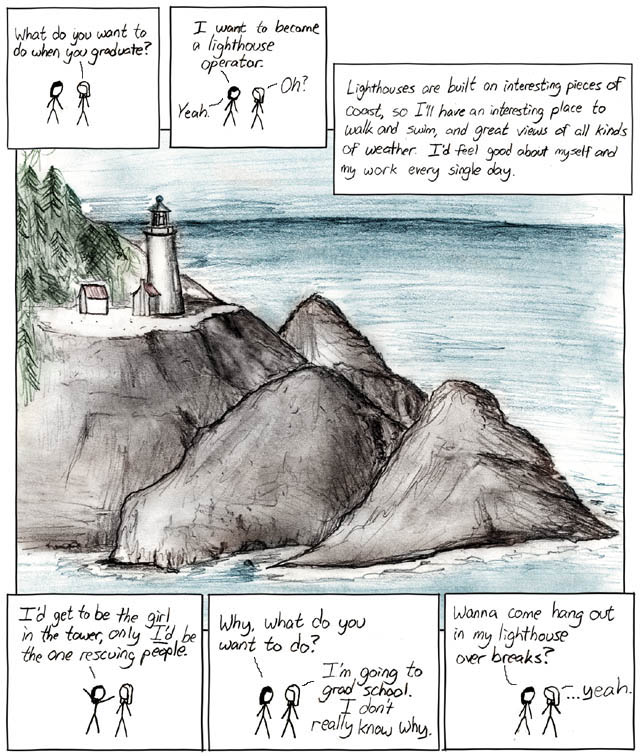
2. The Political Schmientist helped me realize what I want to do with my life.
2
I think I take things too literally sometimes. I've been walking around since I saw that picture saying, "A lighthouse operator! How do I become a lighthouse operator?" Even though I know that's not what I want: I want an interesting place to walk and swim, and a job where I feel good about myself and my work every day, and to fulfill some of my childhood fantasies about being important.

Do they even have lighthouse operators anymore?


1. Massey, Douglas and Nancy Denton. American Apartheid. Harvard University Press, 1998 (reprint of 1995, I think).
2. "xkcd - A webcomic of romance, sarcasm, math, and language." I haven't looked at the rest of it, but, um, YES.

May 14, 2007

another new thing that's just not that new

Apparently a number of people, including some Planned Parenthood volunteers, are concerned about the moral ramifications of using genetic testing to decide whether to have an abortion. Normally I would sympathize, but several are presenting this concern as being somehow in conflict with current abortion support.

People. Say it with me. My uterus belongs to me. Your uterus belongs to you. Legally, I'm not sure there should be any other relevant statement.

Yes, morally, deciding to abort a disabled (or gay or retarded or female) kid is, well, icky. And maybe, in certain cases, wrong. Abortion is morally sticky territory, being that involves the blurring of categories like 'alive' and 'not alive.' Generally, women make serious, carefully considered decisions about their personal, individual situations, which they know much much better than anyone else.

As a consequence, no law ever applies well in these situations. Outlaw abortion (or any type of abortion) and you end up with situations where someone is trying to figure out when a health exemption turns into a life exemption. Ridiculous if it weren't so awful.

For many pro-choicers, this is where it ends, and I think this focus on the legalism doesn't give a clear picture of how abortion actually happens in the real world. Worse, it obscures the other side of choice, which is the choice to have a child and have the resources to raise it. That type of choice is often less important for middle+ class (often white) feminists, and a huge deal for women of color and poor women. White feminists need to be on that shit, because it is also choice, and it is also a way in which women find their reproductive options limited and constrained by state action. And it will reduce the number of abortions: the world's lowest abortion rates are in countries (Scandinavia, the Netherlands) with easy access to abortion and contraception and a solid social safety net. Reducing abortion isn't the point, though: the point is to honor and expand people's choices.

This is the same schema that ought to be applied to genetic testing. Abortion should still be legal for any reason, but we should be working to make this a friendlier world for kids with Down syndrome or other disabilities or, hell, kids. Because outlawing some reasons to have abortion and keeping others will be a disastrous muddle; but helping people know what their options are and have more and better options? and being nicer to kids? Not problematic. People seem to have trouble understanding that not everything icky needs to be illegal. I mean really, if we're going to go that route, we might as well make canned clam sauce illegal.

May 13, 2007

traditional nuclear family

The cast
The Mathemagician - male, 26, math tutor
Deb the Dramaturg - female, 24?, underemployed dramaturg (duh)
The Hipsterest Grad Student (Pterest, with a silent p) - male, 23?, anthro grad student at the local Ivy
Mech - Deb's [male] Israeli partner, 30-something, interested in Judaism, landscaping, and sex education
The Gardener - my girlfriend, currently an apprentice at a rad farm in the suburbs
Me - female, 25, math teacher in hell


The back-story
Deb and the Mathemagician are the lesbian moms. Pterest is the adolescent son. I'm the sperm donor dad. Gardener is my gay male partner, and she and I are supposed to be positive male role models for Pterest, but are always falling down on the job. Gardener in particular is a deadbeat, says Deb, because when she's around she makes cake and indulges us all, then takes off on her next adventure when she feels like it. "Are you going to teach Pterest that people just leave??"

The situation
Pterest asks for advice about using some canned clam sauce on pasta. I say gross. We all get into a big [fake] argument about who's allowing him to eat what and how the moms indulge him too much and why aren't the Gardener and I better role models and why wasn't Pterest helping us clean the house anyway? Deb says, "I'm going out with my other partners now, and so is Mathemagician. You have to take care of our son."

This is what passes for theater around here.

May 11, 2007

in case you were wondering

Dear Clyde,
Thanks for your affection. However, when I leave my room in the morning, what I really want is to go to the bathroom in peace. I don't lock the door because it doesn't have a lock, not because I want you to come in and rub your head against my knee. Also, could you start getting out of my way when it's dark? I stepped on you three times yesterday. I'll try to be more careful, but you're the one with the night vision!
Your cat-mom

Dear 1st and 2nd period class,
I'm sorry I'm so grumpy. I really, really am. You all are great, and have learned vast amounts about exponential functions this week. I did notice.
Your Algebra II teacher

Dear 2nd period boys,
You guys need to shut up. Or stop coming to class, either way.
Same

Dear 9th-grade boys,
I am so impressed with your turn-around the last two weeks. One of you got a 98 for the week - I think it's your first passing weekly grade, and your project looks awesome. It's really cute when you come in during 1st period to get the previous day's homework. Another of you just got into Upward Bound, which is one of the few programs related to the public schools that I can recommend without reservation. I'm so glad that I stuck around that day and was in the room when the coordinating teacher told you the paperwork was too late: another teacher and I ended up finagling you a second (third? fourth?) chance. I fully believe that you and all my other 9th grade boys will escape the sad fates of my 11th graders, become brilliantly successful, and save the world.
Your transitional math teacher

Dear English teacher across the hall,
Jesus H. Christ, please stop the gay-bashing.
Your semi-closeted co-worker

Dear student's older sister,
Fuck you. Ok, also: when your brother gets suspended for threatening to punch me, it's not helpful for your mom to call me up, tell me what a horrible teacher I am, then put you on the phone. Furthermore, screaming at me to tell you my room number will not make me give it to you. And you know what's not smart? Calling me back after I hang up and leaving a lengthy, profane message in which you identify yourself and threaten to kill me. That's called evidence.
Fuck you.

Dear 911 operators,
I've called you more in 2007 than in the rest of my life combined. Thanks for not making me feel stupid when I call and it's not a life-threatening emergency requiring immediate response. I sincerely hope to go back to my normal level of calling, though I understand that part of the increase is that I now know to call 911 when there's a traffic signal out at a busy intersection.
That woman you just talked to

Dear friends,
When you read this, please remember that the good things do exist. I sincerely doubt that the crazy sister is serious. I called the police anyway. They're sending a car out. I'm taking care of myself. Also, just fyi, the adrenaline rush of listening to that voice mail is crazy. However, I still think it's safe to go to school on Monday, and I promise that my personal safety is important. I also want you to know that until 5 pm, today was pretty good. Some kids learned some stuff.
North

May 7, 2007

show me what you got

One of the many pleasures of Lil' Mama's Lip Gloss is the clarity with which it summarizes a particular 3rd Wave narrative arc: lack of confidence solved by greater beauty, life revolutionized, goals accomplished, but of course, "it wasn't the lip gloss, it was you all along." Empowerful lip gloss.


Other pleasures: displays of talent from other dancers, including the boy who tears his glasses off. The ambiguously middle-school setting, complete with lunch trays, old-school iMacs, double-Dutch, and slightly dorky clothes. Lil' Mama's surprising butchness: rapping, the hat, grabbing her crotch. The universal technology, including video-shopped pin with Lil' Mama performing on it, videos playing on iMacs, even the flip book.

Also the beat.

May 1, 2007

we are the only people who have ever lived

"I was going to write about [whatever]" is probably the most over-used intro ever, at least out here on the internet. However. I've been meaning to write about a Times article from April 10 since April 10. Unlike many such inclinations, this one's stuck with me, like a burr that you can't get out of your bootlaces. Thus, today's expression of irritation.

The article in question is about sexual desire, and, specifically, about what determines the gender of the people you're attracted to. Ok. Let me just state, for the record, that gender doesn't affect attraction for me. At least not mostly. Gender presentation does, a little bit, but that's a story for a different time. So when the article suggests that desire may be pretty fluid for women, at least in terms of what our brains do, that rings kind of true. Anyway, I know a lot of women who are kind of flexible, and very few men (though I do know some). Not that that's worth mentioning in the newspaper.

But people! Come on! To argue that men have a fixed sexual orientation that cannot be changed, and that whatever the level of same-sex male desire is, it's fixed? That's just irresponsible ahistoricity. There are a lot of societies other than the modern-day US where men had sex with men at certain times, and with women at other times. See ancient Greece. Also Elizabethan England. Also present-day Sri Lanka, where my housemate says it's pretty accepted that young men will have all sorts of same-sex encounters, because female virginity at marriage is highly valued. Also the down-low cultures in the US. These guys are getting it up for men and for women, and actively choosing to have both kinds of relationships. I'm sure some of it is about limited options (e.g. jail and the British Navy, which was once said to run on rum, sodomy, and the lash), but it happens all over the place. Claiming that "Sexual orientation, at least for men, seems to be settled before birth" ignores the fact that 'sexual orientation' is a concept of the last 200 years at the absolute most. Before that, you did this, and you did that, but it wasn't about identity, and it might change. Unless the professors quoted in the article seriously believe that men in western/European/US culture have actually evolved genetic differences from their ancestors within the last 200 years (and while the Y chromosome evolves faster than the X, 200 years?!), they're looking directly in front of their noses and nowhere else.

Not that I was expecting that they would. Just, you know. That paragraph above? That's introductory stuff. Seems like you might could think of considering it if you're a professor and all.

April 22, 2007

dinner at Loud

Dinner: Whole-grain spelt crepes with Oley Valley oyster and shiitake mushrooms and Mother Earth yellow oyster mushrooms, local nettles, and Valley Shepherd cave-aged sheep's-milk cheese.

Intermission: summer fruit sauce made with maple and rose-geranium sugars.

Dessert: Bassett's coffee ice cream with Nutella.

Wine: Bonny Doon Pacific Rim Dry Riesling.

It was even better than it sounds. And here's our scorecard:

Local (within 100 miles)
Mushrooms, nettles, rosemary, sage, onions, eggs, butter, cheese, strawberries and peaches from the freezer, maple sugar, rose geranium

Partly local (regionally produced or made by a local business from not-local ingredients)
ice cream, spelt flour

Not local
Sugar, salt, olive oil, wine, Nutella, one tablespoon of soy milk

speaking of France

Did you know that Ségoléne Royal1 isn't married? She has four children with her male life partner, and they have a civil union, but she's not legally or religiously married.

It may be hard to believe for those of us in the sex-obsessed US, but this has not been a campaign issue for her.


1. The Socialist candidate for president of France.

April 18, 2007

patriarchy at work

In honor of the Supreme Court's decision, let's all remember who was there when the 'partial-birth' abortion ban was signed.

April 17, 2007

incompetence is no barrier to achievement

Don't read the cover article of this week's NYT magazine. Or if you do, don't say I didn't warn you. To summarize: Thomas Friedman would like us all to know that he has a big dick, and it likes the environment. But not in a "sissy", "vaguely French" way. No, this is a "muscular and strategic" "Geo-Green" sort of dick that considers "the First Law of Petropolitics" in its quest to ravish the world.

Instead, you should read a review of Friedman's book. By the time the Mathemagician was done reading it to me, I was lying on my kitchen floor, convulsing with laughter, tears streaming down my cheeks, whimpering.

April 13, 2007

why hierarchy sucks

I had lots of time to think today. I spent most of it waiting 4.5 hours to talk to my principal. And what I thought about, in that time, is how extremely important it is for leaders of all sorts (principals, teachers, presidents) to be accessible. I used to be able to drop by the director's office at the outdoor ed program where I worked, and I talked to my direct boss in depth at least every other week. It was part of my job and his job, and it meant that I always knew where I stood. The other outdoor ed program was bigger, so we had forms to get signed and mandatory short check-ins every other week, but if you wanted to talk to someone they'd schedule you a time. You can have more formal systems too, like having office hours or a meeting every day or week that's reserved for employees or a secretary who'll make an appointment for you, but you gotta be able to get in touch with your boss. Especially if you're trying to set up some kind of special something for your organization that needs your boss's approval.

What does not work is asking people to stand outside your door at random times until you decide they're worth talking to.

What also does not work is telling them you'll meet with them at a specific time, then disappearing at that time with no explanation or apology.

And if you need a definition of adding insult to injury, it's having your boss finally meet with you, then interrupt the meeting every 30 seconds to talk to someone else.

I'm not saying I'm so important. But I'd feel better about my job and my work if I got treated like I mattered some. Even worse, this is moving up in the world compared to some.

April 8, 2007

time to look in the impossible places

There's a short article in the NYT magazine by Noah Feldman this week that purports to be about the lack of any political candidates with clear statements about how to get out of Iraq. While the article frames it as being about politicians' trying to negotiate conflicting electoral desires and paradigms for resolving the conflict, it's notable for what it lacks: a clear statement of the real options for dealing with Iraq. To my mind, this is because there aren't any. For most political problems (access to health care, the global AIDS crisis, global climate change, crime in the inner city, equal rights for queer people) there's some action the government should take, even if it's not enough to fully solve the problem. In Iraq, all of our possible options are hopelessly compromised: whatever action the US government takes, some unacceptable consequence will almost certainly ensue. Notably, these unacceptable consequences are unacceptable to Iraqis, Americans, politicians, academics, and the world community, meaning that politicians literally have nowhere to go to find a reasonable strategy for resolving US involvement in Iraq.

The conclusion of US involvement in Iraq will only happen once we accept one of the unacceptable consequences. Thus, while the article sets up the problem as one of political will, it's in fact a problem of available options. We're going to have to accept at least one, and maybe more, of the following consequences in order for the current unproductive muddle to end.

1. Genocidal civil war, coupled with a major refugee crisis, destabilization of the region as the various surrounding countries jockey for influence, massive loss of face for the US, and loss of access to Iraq's oil production. I should say, more of these things than we have now. This is the likely consequence of withdrawing all US troops on the timelines set out by the House and Senate bills. No one is willing to accept this consequence explicitly: it's a humanitarian and international-relations disaster. It is, however, very likely to be the consequence we accept by default.

2. A major increase in US troop commitment. Not a surge, not a small escalation, but overwhelming force. Despite Iraqi hostility to the US presence, I think a massive escalation that actually established security and helped rebuild infrastructure might be welcome. You'd need a draft and a complete change in the US political scene. The US wouldn't lose quite as much face, but Iraq would become our major effort for the next five or so years. Say goodbye to any other policy priorities that might compete with the war effort. Also to your male relatives.

3. Giving other countries in the Middle East a lot of say in Iraq. It might work to have a federally partitioned Iraq - something along the lines of the former Yugoslavia - with large protector states for each section. There's precedent for major powers coming together to split up powerless states, and while I don't think it's so great, it might be better than door #1. It might also be possible just to have Saudi and Iranian involvement and protection without dividing up in the country. The downside risk is that, like in Yugoslavia, lots of people might end up having to leave their homes as the ethnic and religious borders got defined, and there would almost certainly be some serious violence and brutality. The US would have to explicitly provide Iran with influence in Shiite Iraq, and the US, Iran, and Saudi Arabia would probably have to be the minimal guarantors of the peace. You'd also need assent from Syria, Jordan, and Turkey - Iraq's other neighbors - though Turkey is pretty likely to just accept whatever it is, since the Kurdish section along its border is relatively stable. There'd be a lot of arguing about oil and borders, Baghdad might have to be partitioned, and it has the potential to set up a major future war about oil, religion, and whatever violations of the peace are certain to happen periodically. This consequence is the least likely to happen, and is also the least defined right now. It carries enormous risks, and might be impossible anyway.

On the other hand, Juan Cole, who, as a professor of modern Middle East history, knows a smidge more than I do about these things, thinks it might work. His vision depends, though, on the US actively engaging with Iran, which is going to take a change of administration at a bare minimum.

The defining theme of these consequences is that Iraq needs some major force if we're not going through door #1. The US could provide it, or other countries could provide it, but I think we've seen that the Iraqi government is, at the moment, totally unable to provide it. Both sides of the American political fight present the canard that "The Iraqi political classes could deliver law and order and reconstruction if only they really wanted to, but their incentive to save their country is somehow reduced by the presence of the U.S.," but Feldman points out that "It is hard to overstate how absurd this view would sound to anyone who wasn’t looking for excuses to withdraw." Basically, putting total responsibility for stability and reconstruction on a brand-new government in an extremely unstable state in which being a member of the government at any level is likely to get you killed? Not reasonable. Not going to work, anyway. Choosing that means choosing door #1.

And what do I think? Well. I don't really know. But door #3 is the only one that might, possibly maybe, not be a human catastrophe. So I'll go with that.


1. The title comes from something my mom says. If you can't find your keys after you've looked in all the possible places, it's time to look in the impossible places.
2. Edited because I read Juan Cole.

best graffiti ever

On the toilet paper dispenser in the bathroom of a BP in Carlisle, PA:

I <3 buckwheat

March 28, 2007

collected notes

I had a dispiriting conversation with a co-worker the other day about what an awful environment my school is, especially for freshmen. I was saying that I didn't understand why certain students - the ones who end up in a lot of conflicts with teachers and are doing absolutely no school work, zero, not even moving towards getting a single credit - come to school. He said he thought that for some students, school is better than home. It's safer and less scary. To put this in context, in the three weeks since the head of the school district where I work announced a zero-tolerance policy for threats and assaults on teachers01 under which any threats or assaults get a mandatory 10-day suspension, one kid has been suspended for hitting me with a door and two more have been suspended for threatening me. Our bulletin boards get torn down within a week, and, in one hallway, there's at least one plexiglass window punched out of a door every week. There are fights between students every day, and constant casual violence that's not quite a fight. It's hard for me to imagine wanting to be there, but I think my colleague is right.

******

Today a girl asked if I was pregnant. No. Are you sure? YES.2 I told her I had my period, and she said, "Oh, that must be why you look pregnant."

To her, there was nothing weird about her teacher talking about her period. I can't even imagine being that comfortable with menstruation or body stuff at that age. It's a great virtue of a cultural pocket where lots of people get pregnant at all sorts of ages.

******

A friend from high school called on Tuesday night. Let's call him Kermit, which is clearly not his real name, but I can't come up with a descriptive pseudonym for him. I think it's because I've known him too long and in too many ways. Conveniently, that's also why I wanted to write about him. We've been friends for something like ten years. He was my prom date, he and I started a surprisingly effective single-issue political organization, he sent me letters when I was at camp in Canada, and yesterday he called to let me know that a political thing I passed on to him is going to pass. I was so happy to hear from him. So happy. And surprised, some, but mostly just happy. He's always been a really good friend to me, and I'm always a little surprised at how good a friend. Surprised? Because when we became friends, I thought of myself as someone who didn't have a lot of friends, and I didn't trust the world that much. Kermit is a prime counter-example for that.

******

He said, as have my parents, that he's proud or impressed or something about me teaching this year. I would feel better about that if I were doing something useful, not just baby-sitting my students through one more year of not learning any math.

******

Someone needs to leave a comment here.


1. As opposed to before, when they were tolerated. I wish I were joking.
2. Do you have any idea how not pregnant I am? I only sleep with my girlfriend who can't get me pregnant, I have my period, and, just in case, I got a pregnancy test last Wednesday so I could get vaccinated against HPV.

March 24, 2007

ill-fated advice

I'm writing from class, which is kind of ridiculous. Then again, so is class.

The people facilitating a 3-hour workshop on working with English language learners for my grad school class are currently off on a tangent about how important constructivist learning and teaching are. Constructivist educational philosophy essentially is about people constructing and developing their own knowledge and integrating real-world situations with learning. It's great. It's how I'd like to teach. But there are two problems, both of them recently voiced by people in this gigantic lecture hall, both of them worse for people who are first-year teachers in disastrous schools.

1. I teach math, and there are specific mathematical concepts I need to teach. While math is everywhere, and I completely, 100% believe that students learn math much better if they see it as a formal way of writing the math that they already do in their lives, it's hard to come up with concrete applications that make everything make sense. Now, if I teach math for 5 years, I'll have a lot more; and there's no excuse for the crappiness of my area and perimeter lessons. But when people say, "Yeah, it's a lot of work, but it's worth it," you have to ask, "For whom? On what time scale?" For me, this week, it's not. I promise. Next week, maybe. Next year, definitely. In the long term, no question at all. But for my own sanity, I need to accept that this year I will teach many crappy lessons that don't fully lead to understanding. I wish I had fewer lessons focused on why it's important for me to teach that way, and more help figuring out exactly how to do that.

2. Another teacher pointed out that our students are mostly used to a mode of teaching that's all about direct instruction and transmitting information. When we try to have them construct their own knowledge, they're like, "You're not teaching!" Martin Haberman wrote about the pedagogy of poverty as a set of teaching methods that rewards rote compliance, but he also pointed out that it has benefits (in terms of safety and ease) for students, and that students often push teachers to use it by complying with the pedagogy of poverty and rebelling against anything else. It takes a while to dissolve this. In an environment in which other teachers are also asking students to question, challenge, and solve problems, that resistance goes away a lot faster. The whole school environment needs to be oriented around learning and problem-solving, not just one classroom. And not just because I'm lazy.

Also. Can I just say. Next person who says "frontloading", "scaffolding", or "differentiation" as if I'd never heard the words before gets a plastic fork in the eye.

January 23, 2007

things that have been said to me today

bad:
"Are you confused? one plus one equals two! two plus two equals four! pussy plus pussy equals dyke!"

"you alien-looking motherfucker"

"bitch" (x50)

good:
"Freedom Writers"

"you want to teach here?"

"you's a boss"

January 20, 2007

roll call

Declared candidacies for US president, with high-school yearbook style awards:

Democrats
Tom Vilsack: Most Boring Candidate.
Hillary Clinton: Most Polarizing Candidate.
Barack Obama: Best Smile.
Chris Dodd: Most Pointless Candidacy.
John Edwards: Best Hair.
Dennis Kucinich: Biggest Nerd.
Mike Gravel: Who the hell is that?

Republicans
Sam Brownback: Attila the Hun Memorial Senator.
Mike Smith/John Cox: Who the hell is that?

miracles are not a policy

I don't know where Tom Moore teaches, or what kind of teacher he is, but he's right on.

One thing I've realized this year is that teaching is full of lovely little moments. I've had a pretty hellacious year so far, I'm not a great teacher, and I still have those moments. And those moments - that's what's in the movies. To string them together into an incredible year, where your work fundamentally changes your students' lives, is an extraordinary achievement. Jaime Escalante and Erin Gruwell and the many, many others who aren't in movies are extraordinary. But the movies - at least if Tom Moore's article and the trailers I watched are to be believed - seriously underestimate the challenges they face, maybe because it's hard to make a moving and comprehensible movie scene out of 30 kids screaming at each other at the same time, or the process of trying to track down bathroom, elevator, and classroom keys, or an activity in which your students refuse to participate pretty much at all.

Worse, just as Moore says, is the idea that teachers can, should, must be heroes. Jaime Escalante and Erin Gruwell and all the other people who change their students' lives are extraordinary. There are 3.8 million teachers in the US. Asking them all to be superheroes and miracle workers is just another way to avoid the real problems of public education.

January 7, 2007

so, what do I think? #2

In that last post about changing public education I talked a lot about money, and I did something that annoys me when other people do it - namely, I bad-mouthed teachers at schools 'like mine.' This annoys me because, hey, you think teachers don't teach well? Here. You try it. Try teaching four periods a day with no office to send kids to, no curriculum for two of those periods, your personal safety in danger, fights on a regular basis, and your students 5 or 6 grade levels behind. Not so easy now, is it? There are a million things I know I should do and just don't, for all sorts of essentially personal reasons about needing time and energy spent away from school.

Last night, I was talking to a friend about her school, where there have been no fights since October 26, 2005, and where the principal mentions that at each Thursday's all-school meeting and there are three full-time deans who deal with anyone who's disruptive in class or talking about thinking about maybe fighting. This is what we like to call a 'support system.' I said that I had realized that at my school, with no support system, it is actually possible to create the support system yourself. I can't do it, but it can be done. She said, yes, but you shouldn't have to, and you can't as a first-year teacher. Which about sums it up.

Basically, being an excellent teacher at a failing school is an almost superhuman endeavor. I think. There are a few teachers who may be counter-examples, but I suspect they pull at least a few superhuman stunts. This is why I have so little patience with people who talk smack about teachers as if we're THE reason public education is so messed up. So why did I talk smack?

Well, mostly because it seems like the math teacher my students had last year just gave them a B+ for showing up. Because my brightest, most motivated students are still mostly behind - and I know it's not their fault because they catch up so damn fast. So. There are at least some really bad teachers out there.

January 4, 2007

sparks

I have to remember the good moments, because the bad ones are measured in hours.

Today, in the half hour before lunch, I offered my room to four junior girls who needed a place to work on math for a test prep class. One of them is the smartest most articulate wundermonkey in any of my classes, who's frustrated in my class because it's too slow: she was tutoring the others (which, by the way, she does amazingly, because she's also a natural at that part of teaching). When we got to the room, another girl was waiting - she spent the next twenty minutes writing down the homework she needed to make up. Twenty minutes in, it was lunch time. An 11-th grade girl who's way, way, way behind (in a class that averages 6 grade levels behind) and trying furiously to catch up (partly so she can be a good mom to her daughter) came in, got a calculator, and sat down with the girls working on test prep. A guy who's constantly trying to improve his grade from, say, a 92 to a 97 (which, at my school, is endearing rather than irritating) came in to catch up on back homework - I told him I'd give him extra credit if he taught inverse functions to the other girl who was working on homework and she did well on a quiz. A 9th-grader started working on a diagnostic test. Meanwhile, four people formed a line to talk to me about why they were suspended and what their grades were.

That was when the principal walked in. She said, "What class is this?"

It's not class. They're here because they want to be.

December 30, 2006

so, what do I think? #1

I teach high school math in a very poor, very violent neighborhood in a major US city with a really bad school system. I'm a first-year teacher, and it's a mess. My background is intellectual, upper middle class, focused on social responsibility, politically active, and liberal: that describes my parents and grandparents, and the parents of many of my friends. Almost none are teachers. Periodically, people ask what policies I think would improve the public schools. Recently, a stranger on a plane asked. This is the first of what I hope will be an occasional series exploring some possibilities. I'm interested in seeing how my thinking changes over the next year and a half.

To put one of my premises out there: I imagine, as I say these things, a conservative (like one I recently met on a plane) saying that parents should be responsible for these changes; that expectation is not reasonable or realistic, for reasons I might write about later, and really I think it's irrelevant. Do you want students in low-income districts to have the same educational opportunities as students in wealthy districts? Yes or no. If yes, saying parents should be responsible is a cop-out, unless you have a plan to make or help parents be responsible. Without further ado, the proposals.

1. More money. Schools in impoverished areas shouldn't get funding parity with wealthier districts - they should get double the per student funding. Among other things, parents in wealthy districts provide a vast number of resources that poor parents simply cannot provide: graphing calculators that students can use at home, buying college reference books, making sure their students get therapy or medications if they have mental illness, dental care, computers and internet at home - the list goes on. Money is not the only thing my students need, and more could certainly be done with the current budget, but let's be real: many of the people who refuse to throw money at the education of poor children are the same ones who throw money at their own children's education. They're not doing that for nothing.

2. More staff. See #1. Having someone constantly available to manage a student who's out of control (e.g. an office to send that student to) would free up a lot of my time to actually teach. Instead, what happens is that if a student disrupts or endangers the class, I write up a disciplinary referral and it gets dealt with later; if I'm really lucky, someone will be available to take that student, but those people all teach their own classes and are pretty overworked; they also don't have anywhere to put the student where the student will be supervised. In better-functioning schools, you can just send a kid to the office for cursing at you; in my school, no way.

More staff also means smaller class sizes, which, wow. That would be awesome. Thirty-three kids is a lot. Maybe even having two preps be standard - I have that this year, and it's great, and I don't know how I functioned without it for 2 months.

3. Better staff. The quality of most teachers is, well, not stellar. (I include myself in this, though I think one way in which I am unlike many of the other teachers at my school is that I really want to get better.) The recent NYT magazine article about the achievement gap and the KIPP schools casually mentioned that KIPP teachers work 15-16 hour days. That's great for the students, but it's not a national policy solution. You can get a few more smart, motivated, ambitious, etc, people into teaching by upping the mystique, and a lot more by making public schools better work environments, but to do this on a national scale you'll have to up the salaries. That kind of time commitment is what people do in I-banking, where they are making boatloads of money. I'd suggest making teacher schools something like law or MBA programs, where you worry about whether you'll get in and have to be intensely devoted to it for at least a year or two; I'd also suggest having teacher salaries start at $60,000 and go up to $150,000. You could even start lower if you were willing to make the ramp pretty steep. Teaching will never fully compete with Wall Street - that's not the idea. But you want a lot of talented people who have other options? You're going to have to pay for them.

I am not sure if doing that would produce a system where I wanted to work right now. For me, teaching was a step up financially, and I was fine with that. But realistically, money is a great way to attract people to a particular job, and while that kind of environment might make me less interested in teaching now, the money (and the doubtless improved work environment) might also make me more interested in teaching long-term.

4. Better management. See #3 and #1. Management at most public schools is abysmal. I have this fantasy of having professional development that's not a complete waste of my time, seeing the teaching schedules for half-days and special events before the day of, and getting feedback from observations. This, again, you have to pay for.

5. Better staff/management development. I'm going to write more about this another time.

6. For the luvva Pete, can I please just have a curriculum for every class? And maybe a computer in my classroom? And while I'm wishing for the impossible, how about paper for the flippin' copy machine?

Idlewild

What's most interesting about Idlewild (OutKast's gorgeous movie set in a semi-mythical Prohibition-era Georgia) is not what it owes to the past, but to the present. The score, of course - there's no way those songs would have existed 'then' - but also the dance scenes, floating somewhere between musicals and music videos, and the characters.

It's simple, really. Before there were gangstas, there were gangsters; before there was crack, there was hootch; before there was the club, there was the club. More complicated things, too: the role of women as simultaneous seduction and salvation, the dream of getting out, the fear and reality of violence, having to choose between being cool and having a future. Idlewild is about now, dressed up as then. Elijah Anderson's Code of the Street is about the same subjects, but it's not half as pretty.

December 27, 2006

home is....

Three full-time residents, three cars. Looking around a roomful of friends and realizing I've known everyone in it for over 10 years, except for the little siblings (I met them 8 years ago). Bonjovi on the radio. "You only bought two and a half pounds of green beans? That might be enough for your little brother.... by himself!" Constantly being interrupted. An orange and a penny in my Christmas stocking; also contact solution. At least two glasses of wine a night. The promise of the interstate. New bars with exciting beer lists and murals - what's happening to this place? My grandmother's artwork on the walls. Scraping the frost off my car before I can go anywhere. Buying rounds at the bar. My dad making cappuccino. Watching most of the first season of Big Love on DVD. My little brother at the computer. Being the only one up at 2 am. Borrowing cash from my mom to go out for a beer. Drinking cream soda and root beer. Apple pie. A golden retriever sleeping sprawled between the top of the stairs and the door. Strip malls. When the cop who breaks up the [very quiet] party is my high school biology teacher's son. Sleeping until noon. Homemade granola. Tonight's dinner question: what would you do about Iraq? They let you smoke in the bars. Almost certainly being safe to drive. My sister napping on the couch. Mexican wedding cookies, molasses-ginger drops, sugar cookies, and lebkuchen. Emmy Lou Harris singing "Light of the Stable." Knowing how to get everywhere. Do you want to talk to someone on the other side of the house? No need to go anywhere - just shout! Knowing that Git'n'Go used to be a QuikTrip. Winter grasses at the edge of the garden. The lieutenant governor coming over for brunch. Frustrating and comfortable. Drinking beer in an outdoor gear outlet store at 3 am because my friend is the manager, and the cops broke up the party at her house. Dancing to Journey. My friends' parents. Hearing about Catholic Worker houses. Hypothetical karaoke. More prosciutto than you could possibly eat. Drinking champagne. The dishwasher running constantly. Driveways with basketball hoops. Someone has to go to the grocery store every day. New kittens. Two dogs. Trading Christmas cookie plates with my friends' families. The gold dome of the Capitol building. Being surprised by how white everyone is. Driving past my high school. Reading articles aloud to each other. My mom asking what I think of the garden. Red pepper pasta sauce. Adriatic pita bread. Blessings for the road. Never wanting to stay. Never wanting to leave.

December 22, 2006

sex-neutral

In 2005, I borrowed a book called A Return to Modesty1 and got kind of annoyed with it.

Conveniently, someone else has written the same book again, so I don't have to come up with new ways to be irritated. Dawn Eden2 is older, and she became an observant Catholic instead of an observant Jew, but it's basically the same old same old. Some woman becomes religious, stops having sex, and realizes how much happier and more fulfilled she is when she's chaste (or celibate or modest or whatever) and religious. Next step: publish a book so all the rest of us can learn how to be just as satisfied with our lives.3

The arguments are oddly similar to the way polyamory advocates sound sometimes: "Why didn't I know about this before? I spent all that time trying to be [monogamous/promiscuous]! I never realized that I actually could sleep with [lots of people/no one] without being [skeevy/lame]!"

The most noticeable aspect of this interview with Eden is that the focus of her romantic life, both before and after she was celibate, was primarily on finding a husband and secondarily on relieving her insecurities about being good enough and lovable enough. Note that when she talks about her pleasure in sex, she says:

There were times when I would count how many men I had had sex with in one two-week period and thought, "I must be this really hot, attractive chick to attract so many men."
Also:
I used to believe that, if I knew that I would never get married, I would kill myself.
Not anymore, but now,
as I was writing, I didn't want to think of what would become of me if I didn't get married. It was too frightening to imagine.
It gives you a sense of how central the idea of marriage was and is to her life. Also of what she sees as the alternative.

If you desperately want one kind of relationship, and start pursuing something completely different, you'll be unsatisfied. No real surprise, then, that when she stopped sleeping around and started looking for something she actually wanted, she got happier. Chastity, in Eden's view, is about not pursuing sex, but instead pursuing serious relationships with people whose values you share.
Instead of following the pop-culture prescription, to single-mindedly pursue a man who's going to make you happy, I am suggesting women should be singular and concentrate on being the best people they can be and displaying grace as individuals and as women. In doing that they will become more giving, more appreciative of everyone around them, so not only will they be better able to have meaningful friendships and relationships, but they will also be able to enjoy this time they have as singular women.
Similarly, she says chastity made her a better friend: before, her romantic life and friendships were about activities, and now both are about values and intense personal connections.

I have no doubt whatsoever that this transformation happened in Eden's life. But check it out: fundamentally, none of this is about who you have sex with. It's about caring, respect, connection with other people. For her, that happens through her relationship with sex. FOR HER. But she, like a lot of conservatives, conflates values with sex; like Wendy Shalit, she assumes that because she fundamentally wanted marriage and preferred chastity to promiscuity, all other women want that too.

I think, honestly, that it's a failure of imagination on her part that makes this happen: for her, relationships are either permanent or superficial; either no sex until marriage, or promiscuity. It's a false dichotomy, not just because there are possibilities between those two extremes, but because there are possibilities that combine those qualities, or have neither of them. It's also a way of trying to get people to be less obsessed with sex that is, itself, incredibly obsessed with sex.4 Really, the most telling line in the whole interview is her summary of her message:
It's about having substance as a person, seeking out friends who have depth and substance.
But why exactly does that have to be about sex?

1. By Wendy Shalit.
2. The Thrill of the Chaste.
3. Start following the Amazon links for those two books to find a few more. Their covers even look similar - part of a woman's face in some kind of old-fashioned painting.
4. The most extreme example of this I know is Westboro Baptist, who protest 'gay-friendly' organizations like the U.S. military with signs that depict sodomy using stick figures. That shit is weird.

December 13, 2006

whoa

"This unconstitutional darkness, we will stab at it with our dagger until we kill it."

December 8, 2006

what to eat, #4

Those who know me (and if you don't know me, why are you reading my tiny-ass blog?) know that about three quarters of my cooking is slapped together by remembering what someone once said was the right way to do something. The other quarter involves obsessively reading every recipe on the subject and calling my mom at least twice. This is the first kind of recipe.

Roasted Root Vegetables with Basted Eggs1
What to buy
a buncha root vegetables. potatoes - yellow, purple, white, mixed fingerlings, who cares? but let me know how it goes if you try new potatoes or the big Idaho bakers; sweet potatoes; parsnips; beets; celeriac; salsify; carrots if you want, but I don't think they're much of an enhancement.

eggs. spring for happy local ones if you can, and goggle at the deep gold of the yolk.

a box of chicken broth. completely optional - you can also use veggie bouillon or water, but I really like the organic free range chicken broth at Trader Joe's, and think it makes the eggs better. you only use maybe a tablespoon for this recipe, so make sure you'll use it for something else.

What you should already have on hand
some olive oil
a little butter
salt
pepper
garlic
maybe some rosemary or chives or something, but don't stress

What you do
1. Roast the veggies. Turn the oven up to 450, then wash 'em, peel the skins if you don't want to eat them, and chop them up into half to one inch chunks. Put them in an ovensafe pan, toss in enough olive oil to coat them very lightly, and sprinkle the salt on (also lightly). Peel a few cloves of garlic and put them in the pan whole. They're gonna turn into practically spreadable, unbelievably delicious little nubbins of roast garlic. Stick the pan in the oven. Start checking on them after 20 minutes, and pull them out when they're all cooked through (soft, but not custardy).

2. When the veggies are done, make the basted eggs. (Side note: I have no idea if this is how you're supposed to make basted eggs, but it's working for me right now. This was my big revolution in egg frying - before, I was really bad at it, and always broke at least one of the yolks. This way? It works.) Melt a little butter in a small pan on low. Keep the heat really low! Otherwise the eggs will be too tough! Crack your two eggs in there when the butter's all foamy. Once the bottom of the clear white has turned actual white all the way around the egg (while most of the depth of the white is still totally clear) slide your spatula under the eggs so they don't stick. Salt and pepper the eggs, and put a little rosemary on them if you want. I love eggs with rosemary. Now add a slug of chicken broth (or water, or veggie broth, or whatever) to the pan, and cover it. What's a slug? Who knows.2 Let it cook for a few minutes, or til almost all of the white is cooked. Flip the eggs over carefully, cook another few seconds, and slide them out onto a plate. Serve yourself some veggies, too. Yum.

3. Got buttered toast? You just made yourself an upscale diner breakfast for dinner.

I ate this 3 times this week - once fresh, twice with the left-over veggies reheated in a pan. I'm still not sick of it.


1. Hat tip to the Gardener, who made the first batch of roasted root vegetables this is based on.
2. I feel like people laugh about 19th century (and earlier) recipes that tell you to put in a handful of this or a pinch of that, but seriously? That's what my recipes, and my mom's recipes, and most of my friends' recipes tell you too.

December 1, 2006

how you know parents are on your side

"I think you owe her an apology."1


1. Especially when closely followed by "Ain't no 'sorry.' What are you sorry for?"

November 28, 2006

what about misconception care?

While I could say any number of serious things about this article, all I can think is come on, preconception care?

November 16, 2006

hello, Gorgias

This Salon article - one of the ones you need to watch an ad to see, but worth it anyway - is all about rhetoric, sophists, and philosophers.

November 13, 2006

you have to ask why

There's this idea that seems to be ambling around the feminist blogs whenever people start talking about appearance culture. You might see it in the comments on I Blame the Patriarchy (it's probably in this comment thread somewhere), and I don't know where it comes from. To summarize: "Individuals decide who they want to please (and yes, there’s no reason it has to be men), and that.. is a healthy part of social existence. In other words, the problem isn’t pleasing people."1

Ok. I'm going to try not to dump my irritation too heavily on this particular person's head just because he's got a convenient summary. But let's review. It's true, most of us like making other people happy at least some of the time. However, I think we can agree that pleasing people usually means fulfilling their desires. The one thing we can all agree on - Puritans, post-modernists, neo-Aristotelians, feminists, Marxists, maybe everyone except modernists and the occasional Third-Wave feminist - is that desire is not neutral. People want things for all sorts of reasons. Maybe it was on TV a lot when you were a kid.2 Maybe you had a secret crush on your 3rd grade music teacher who always wore that kind of shoes. Maybe you're color-blind and like really really bright colors because you can see them. Maybe desires for sugar and sodium were evolutionarily advantageous to our primate ancestors. Desire comes from a lot of different places, and so when we think about pleasing other people - about our desire to fulfill other people's desires - we need to think critically about where that need to please comes from, and where the specific desires we want to fulfill come from.

It is my belief that most women's desire to 'look pretty' comes at least partly out of patriarchal bullshit on one side or the other. Kugelmass does say that there's a problem "that women are expected to do more to please men than vice versa," but I don't think he gives this problem enough attention. In fact, women are required to put vastly more effort into their appearance than men. There's the time spent picking out clothes so we look just sexy enough (but not too sexy! then we're asking for it!); even professional clothes are a lot more work for women. There's the grooming regimen: at the bare minimum, shaving legs and underarms a couple of times a week, skin care and moisturizing, styling hair, haircuts every 6-8 weeks or fairly maintenance-intensive long hair, and most women add on at least a few other things, like nails or eyebrows or make-up (in some places and jobs, these are required). There are the shoes, and anyone who's ever tried to find comfortable, professional women's shoes knows exactly what I'm talking about. Ah, you say, but women are free to reject these 'requirements' - they really are, at least mostly, about choosing to please other people. You yourself just ignore a lot of these so-called requirements.

That's true, I don't, but I'm under no illusion that I don't pay a price for it. There are a number of office environments - including some of the most prestigious and best paid - where I couldn't work looking like I do. There was a New York Times article in the last year or two in which women on Wall Street talked about how they resent the brutally uncomfortable shoes which they feel they must wear in order to keep their jobs, but which damage their feet permanently. Some of the benefits of meeting the requirements of conventional femininity are just things I'm personally prepared to do without: I'm queer - right now I'm dating a woman, but my queerness means that there are a number of straight guys who just aren't really dating options for me, and that includes most of the ones who care about all the beauty shtick; I don't want to work on Wall Street, or for a high-powered legal firm, or in most office environments; I'm willing to accept the incidental damage it will almost certainly to do to my career. This shit is coercively enforced, and while you can opt out of the work, you pay a price.

So that takes care of why women want to do their pleasing in this particular way; let's talk about why men (or heteronormative culture) enforce these particular standards. Hint: it's not handed down with our genetic code. There are a lot of specific standards, but let's look at three that have particularly elegant patriarchal implications.

1. Shave off your body hair. This makes women look young (pre-pubescent, ick) and powerless. Nuff said.

2. Wear high heels. This makes women actually physically powerless, because we can't run or move freely; it also damages women's feet. Compare to the tradition of foot-binding in China or corsetry in the Victorian era - it's just not that different.

3. Be skinny. There's much to be said here, but what always strikes me about the obsession with thinness is that women aren't supposed to take up physical or metaphorical space.

The people making the argument that it's cool to want to please people - Kugelmass included - seem to ignore the actual content of what it takes to please others, putting the beauty ideal in the same category as cooking your friend dinner once in a while or remembering your Mom's birthday. It's different, and it's different because the desires we're trying to fulfill are social, and systematically oppressive to women. Maybe the worst part is that I really believe that appearance culture is a collective action problem. Here's what I said on Bitch, Ph.D.'s blog:

As long as most people try and get as much as they can from it - by trying to be as conventionally attractive as they personally can - all the flack from it continues to fall on people who can't conform (fat folks, butch women, short men, people with less money). This, I think, is where Twisty's point about femininity being a survival strategy comes in: even if you identify as femme/femmey, even if you actually get some personal satisfaction out of wearing low-cut shirts/high heels/lace underwear, being femininely attractive still gets you cultural approval that other folks don't have access to and makes it harder for those folks to fit in (or survive) by reinforcing our messed up norms about attractiveness. So you have to weigh what you need to survive or feel ok in your own skin or your own life against the social effects, just as you do when you buy groceries and have to choose whether to spend another few dollars on having it be organic so you feel better about yourself or a little less money so you can make it to the end of the month without being broke. For each decision, it's about whether it's going to make your life better, and whether it's going to make the world a better place for you to live in.

You can't just say that pleasing people is fundamental to being social. You have to ask why you want to please those particular people, why you want to do it the way you do, and what effect it has around you.

1. From Joseph Kugelmass, who introduces his post by saying "I really don’t want to fight a bunch of different battles when it comes to gender. I want to fight just one battle, for equality of the sexes. Which is why I’m sorry to report that I find I Blame The Patriarchy alienating, and have to respond to the latest post there." Sorry dude, you don't get to decide that there's only one feminist battle. Also, hey, you find I Blame the Patriarchy alienating? No way! You and 97% of the human race! And Twisty, she does not care. It's part of why she's cool.
2. In a fascinating bit of correlation, women who watched a lot of Disney movies growing up have notably more conventional ideas about gender than women who did not. (This from the prestigious journal, 'some chick in my grad school class.')

November 8, 2006

yes

“I came to teaching to touch lives and educate and be this enchanting artist in the classroom,” she says, “and I have done nothing but lose 10 pounds in a month and develop a disgusting smoking habit. These kids need something much greater than anything I can give them. They need a miracle — and they need a miracle like every day.”

so far

I've been pushed, shoved, and lifted out of the way, ducked around, called dyke and bitch, had my hair and shoes insulted, been told to quit, that nobody likes me, and that "I will hurt you," had my stamp, stamp pad, coffee mug, clipboard, transparencies, marker, pencils, and wallet stolen, been full-on cussed out 7 times by 3 people, been sorta cussed out at least every other day and usually a couple times a day, had my fingers slammed in my classroom door, had paper balls and pens thrown at my head, and had the plexiglass window in the door to my classroom broken out of its frame. And this is just what I remember.

October 15, 2006

Joy

You know what's awesome? Being the only one in the house so you can play Lucinda Williams loud at 8:35 AM. You know what's even better? Eating apple crisp and drinking tea and looking at the sunny October morning while you do it.

October 4, 2006

medium picture

Go read this now.

As self-obsessed and miserable as I am right now, thinking about the future of the country in light of the basic realities of one part - just one part - of our general situation can make me even more miserable.

Then sign up to give time or money to elect Democrats this fall. Not that it'll change much, but even changing a little is so, so, so worth it.

September 20, 2006

vampyros lesbos

I have a gay transgender vampire in my 2nd period class.

And that is the least of what's happened to me today. Absolutely the least of my worries.

September 16, 2006

tips

1. For straight teacher/educators who want to support queer teachers/educators: don't tell your kids you're straight. I realize queer-friendly straight role models are important, but it'd be nice if not denying you were gay didn't automatically mean you were.

2. For people who post in women-seeking-women on craigslist: don't mention your last relationship, the eighteen criteria any woman you date absolutely must meet, how lonely you are, or how much craigslist sucks. In fact, don't provide any meta-context for your ad at all: just talk briefly, amusingly, about how cool you are and how you'd like to meet someone for x pleasant, non-threatening activity.

3. For publishers of math textbooks: putting the section on solving equations after you've already been working with equations for 5 sections is dumb.

4. For principals of public schools: I'm probably better than nothing, but not much. I'd take half my current salary for half my current workload, no problem.

5. For my students: if you want to learn some math, you eventually have to do some math problems. That's how it works. You also have to come to class and do your homework. 9th graders, this goes double for you, because even if you've already been in a room where someone talked about it, you didn't learn it then.

6. For myself: if you haven't been hungry for two weeks and have therefore been getting your sustenance mostly from yogurt, fruit, toast-with-peanut-butter, and ice cream, and then suddenly eat a full dinner followed by pizza for lunch the next day even though you're still not hungry, and you're really stressed out and feeling like crying before you have the pizza, you shouldn't be surprised when you get a migraine.

7. For the creators of Algeblocks and the fabulous college professor/7th grade math teacher who gave me a set: you are both incredibly awesome and should know it.

This message, like my lessons, was brought to you by the extraordinary Gardener, who has been lovely to me the last few weeks, and the amazing Mathematician, who has been feeding me dinner and math advice since it all started.

also, Political Schmientist: my classroom still looks much as it did when you left, except someone wrote "ASS" on Lundberg.

July 24, 2006

at the last minute, extra work!

we are not there yet. we will never be there. I hate everything.

July 17, 2006

sometimes, things actually are inspiring. especially when you're in survival mode.

My dear friends (yes, you are my friends not merely CMs),

This is the low point of Institute. Week 3 has the most dues dates, the highest stress levels, the fewest hours of sleep and the most frustrations of any week at Institute. You can do it!

Week 3 is NOT indicative of the life of a teacher. You are learning to teach. It is difficult. That is why most ed. preparation programs require years of student teaching. We do it in 5 weeks. There is a lot to learn in 5 weeks. You can do it!

The life of a teacher is not one of day-to-day survival. It gets easier. You will have time for your friends, significant others, favorite TV shows, and life outside of teaching. You NEED a life outside of teaching. The life of a teacher is not Institute life. You can do it!

I have already seen so much skill, knowledge, talent, and drive in each of you. If I didn't think you could do it, then I would have told you by now. It is unjust to make you work this hard if it is hopeless. You will all be good teachers, but it may not happen over night. Be patient. Take one step at a time. You can do it!

Look out for one another. This is our Institute family. We have made it too far to let any our family members struggle alone. Be there to empathize and to add a little sunshine to a teammate's day. Plan a cheese steak social or two. You can do it!

Lastly, I wouldn't get out of bed every morning if I didn't have 16 great colleagues. I wouldn't live this lifestyle for 5 weeks if I didn't believe that ALL of you will achieve success with your students over the next two years and beyond. I wouldn't encourage you to teach if it meant you had to be a martyr and live everyday like a day at Institute. You don't. I do it because y'all are the good teachers that my students need.

I'll be in my room with the door open after the movie.

-S.

July 13, 2006

summer

Summer smells like sweet corn and stone fruit, clean dirt and rain, sweat and cedar.

This summer also smells like permanent markers, sharp nerves and chalk, stress, raw onion, white cheddar popcorn. And tonight, a little like sweet corn.

I am going to make it through this summer if it kills me.

June 1, 2006

this is criminal

Michael Lewis, an eighth grader who was expelled from Baker Middle School for fighting, said he had not gotten into similar trouble back in New Orleans. "You can't really hardly communicate with other people" in Baton Rouge, he said. "I don't know why they have such a grudge on us. They just do."

If it were not for the hurricane, Michael said, he would be enrolled. "I love school," he said. "There's no place I would rather be, during school hours, than school."

Mr. Cowsar said Michael had asked to join his group, whose efforts to become an official charter school have faltered. The group lost financing for the two teachers it had in the fall, and it had only a couple of volunteers to handle about 15 children ages 4 to 14. There was no room for Michael.

Michael said he had wanted to go to summer school, for which parents must pay in some districts. At any rate, he said, his mother did not have time to sign him up. "I want to stay in a child place," he said, "but life keep putting me in a man's place."1


There are kids like him everywhere. Most of them aren't as eloquent. Either way, it breaks my heart. When a kid like this can't get a decent education even when he tries, something is terribly wrong.

March 19, 2007: Now that I'm a teacher, all I have to say is: I don't feel the same way anymore.


1. from The New York Times

give up

I can't keep my mouth shut about politics, which is how the Political Schmientist and I ended up having a full-volume conversation about the risk of American fascism at 11 pm in a campground in a national park in Utah. I'm sorry to anyone I kept awake that night.

This article by the Apostropher says much of what I would like to say.

"There is no war on terror. There never has been." He points out that the forces supposedly arrayed against the United States are incapable of toppling the rickety governments of countries whose populations sympathize with them, and have as much chance of bringing down the United States as of breaking up Mars to mine it for its iron.

He also points out something important: this is a war about resources. We are, as far as I can tell, nearing a historical point at which water and oil, among others, will become extremely valuable. The government of the United States is trying to ensure that those resources, so vital to the way we live right now, continue to be available to us, and cheaply. That's why we're not being asked to sacrifice materially.

Bitch, Ph.D. describes our options as, "We can go down fighting, or, you know, we can sink the money and manpower into finding ways not to go down." Personally, I don't know if there are ways for us not to go down. We may already be totally screwed. What I do know is that if we wish to stop this resource war, if we want a chance to live in a world that is not scrambling and killing over oil and water, we - we Americans - need to stop using so goddamn much. We need to give up our SUVs, our elderly Volvo station wagons, our golf courses, our imported bananas, our cheap vacations: we need to give up the way we consume resources.

It may not be enough. There are 6 billion people on this planet, and we may not be able to give up enough. But unless we try, we are making demands on our world that will require a vast and violent scramble for resources. We have to try.

I don't need to tell you what the chances of this actually happening are. I'm not even trying myself.

April 9, 2006

living in hope

Part of the reason I'm grumpy today is that I have the overwhelming sense that the world is going to hell and there is absolutely nothing I can do about it. The New Yorker article about Iran,1 the NYT Magazine article about abortion in El Salvador,2 the Duke lacrosse case all contribute to that feeling, but it started in a conversation with my dad.

My dad went to Harvard in the late 60s and early 70s, and so did his best childhood friend. He sums up his time there by saying that when he got there, you had to dress for dinner; when he left, there was co-ed skinny-dipping in the Adams House pool. It sounds flip, but it wasn't, really. It meant that Harvard had liberalized, that it was going to be a democratizing force, educating women and people of color and poor people and rich white men all together and helping make a new world.

It didn't, of course. My sister's going to graduate from there in two months, and she talks about it as a place full of social climbing, personal greed, and privileged ambitious people who feel they deserve their privilege.

My dad's kind of upset about this. I think it's because he had an image of Harvard that's idealized in a way I can imagine my image of Swarthmore becoming idealized. He remembers having amazing intellectual conversations. He also was part of at least one sit-in, which I found out about when I found the t-shirt with a red fist on it in his closet. The Harvard student body doesn't go in for that sort of thing anymore, as far as we can tell.

Anyway, all this got us talking about how, in that time, people believed in the power of sit-ins and activism and marches in a way that we don't. That I don't. I went to a lot of protests in college, but more because I couldn't think of anything useful to do than because I thought we would change anything by marching. All those strategies have been worked around and worked into the category of normal disruptions and don't constitute the kind of major challenge they used to be. It's what I think Foucault says in Discipline and Punish3 about challenges and repression getting sucked into the social order.

So I said to my dad that I couldn't think of anything to do that would actually address the problems I see in the world. Nothing that would actually do any good. I have no faith. He went into a speech about how, first, as humans we need some hope and we need to feel like we're doing something, or why not go be a ski patrolman?4 And second, the basic problem is campaign finance.

I don't know about the second. The first, though, is exactly the problem I'm having. My dad seemed to think that I was giving up hope and not doing anything; the problem is more that I feel that exact need and can't figure out how to direct it. When I was a high school activist - and a pretty effective one, considering - I felt like my choices, once I saw the injustice of the world, were to either accept that injustice (which meant defeat) or to fight it. Fighting was the only choice that had hope. These days, I'm having trouble mustering up enough hope to go on fighting.

On this day of all days5 I got an email from an old high school friend who just left his job as a union organizer, donated his car and all his savings to charity, and founded a religious activist center called the Burning Bush: Center for the Working Poor in L.A.6 I can't think of a more profound choice to live in hope than that.


1. By Seymour Hersh. Summary: Bush wants to go to war with Iran and change the government there. No one else thinks it's a good idea, politically or militarily.
2. It's illegal. Period. And the ban is enforced. Bitch, Ph.D. has the stunning quote: forensic vagina inspectors.
3. Which I haven't read, like most people who talk about Foucault. Also, did you know he used to be a big figure in the SF leather scene?
4. My dad was a ski patrolman, and he quit because he felt like he was just having fun and not doing something to make a difference. Oddly, that resembles my position now.
5. Before I get too cosmic about this, I should point out that it's the first day in a week that I've checked my email.
6. For those keeping track at home, this is the acquaintance who burnt all the teachers and the administration on all the activist clubs his senior year by advocating intensely for condom machines in the bathrooms, leaving us unable to find teacher sponsors for my last two years there. He also read Saul Alinsky in high school and was as dedicated (and mostly effective) an activist as I have ever met; so were his older brothers. The condom machine campaign was basically cover for a successful attempt to get a peer sex ed program in our high school. Finally, he's the one who thought I had no sense of humor because I didn't think his sexist jokes were funny. While my high school memories of him are slightly bitter, every time I've run into him since high school has been pretty awesome, and I've liked him a lot.

a better account of the emotions

The Hipster Monk once sent me a pretty awesome interview with Martha Nussbaum in which Nussbaum argues that one of the biggest problems with modern political theory is that it provides an inadequate (and basically non-existent) account of the emotions. This article on Alas, a Blog reminded me of it.

That's all I have to say right now. I'm kind of grumpy.

April 3, 2006

intentions

In the same year that I took that class on genocide - the same year in which the US went to war in Iraq - two eminent persons came to Swarthmore to argue publicly about whether we should support that war. They were Mark Danner, arguing against war, and Leon Wieseltier, arguing for it, and what I remember is being in the big main-stage hall, listening to them. Mark Danner is only about 6 years younger than Leon Wieseltier, and they are both younger than both of my parents, but somehow the impression I have in my head is of a grand old man arguing with a younger, well-spoken but less impressive Mark Danner. It's partly because Leon Wieseltier has this wild head of white hair, and partly because Mark Danner looks young and is short. Wieseltier is also one of the most articulate people I've ever heard - he's The New Republic's literary editor - and the combination of that and the general impression meant that even though I agreed with what Danner was saying, Wieseltier seemed far more persuasive that evening.

But he was wrong. He and Danner are both good people, people of conscience, people who, like me, wanted to see Saddam Hussein out of power but weren't sure they trusted Bush to do it. The difference was that Wieseltier looked at that problem and decided that, regardless of the means, regardless of the instrument, Saddam Hussein was a genocidal tyrant and removing him was the right thing to do; he argued that we were all bound to support the goal of getting rid of him, despite our fears about what would come after. Danner, like me, thought that war itself and what would come after might be so devastatingly bad for Iraq, the Middle East, and the world that we could not in conscience support Bush in going to war, not when we knew that his intentions and plans were so different from what would actually need to happen to create a tolerable postwar situation in Iraq.

If you ever wanted proof that intentions matter, this is it. What's happening in Iraq right now is a disaster, and it's because the people running this war had the wrong intentions. Their intentions shaped how they went about this war, and because of those intentions as much as anything - because of the way the war as been waged - Iraq is a chaotic, terrifying disaster, the US has negative international credibility, the US military is engaging in torture, and both the Middle East and the world as a whole are less stable.

April 1, 2006

genocide

The war in Iraq has entered a bloodier phase, with the killings of Iraqi civilians rising tremendously in daily sectarian violence while American casualties have steadily declined, spurring tens of thousands of Iraqis to flee from mixed Shiite-Sunni areas.

The first thing I thought of when I saw this article - even before I read it - was this class I took my senior spring. I had been planning to take a class about moral decision-making and political theory, but it was a lot like the amazing seminar I'd taken the semester before, and in the first week of classes, I heard about a directed reading1 on genocide. I went, and I felt this sense of responsibility, like even though it meant studying all of these incredibly horrific things, I couldn't possibly not take it. For the rest of the spring, I would periodically walk into the Hipster Monk's room and scream, because the things I was reading about were so horrific. The Political Schmientist is studying human rights violations in grad school right now, with some emphasis on sexual violence, and I think she's having a similar experience.

Folks, that's what's on its way to happening in Iraq. The NYT article I linked to doesn't have a lot of the explicit details of violence that are so difficult to read about, but the process it describes is familiar to me. Iraqis are starting to be scared - and apparently reasonably so - to be ethnic or religious minorities. They are leaving their homes to go to places where they will be members of the religious or ethnic majority, despite a long history of fairly peaceable coexistence and despite the major financial costs of doing so. Civilian casualties are increasing, not decreasing, and the focus of the violence is gradually shifting from Americans to Iraqis.2 These are warning signs of civil war, and especially of a civil war with the potential for genocide. The situation reminds me a great deal of the former Yugoslavia's disintegration: get rid of a violent dictatorship that overwhelms ethnic tension, then watch as the record of prior coexistence gets drowned in appeals to nationalism/sectarian ideology. Watch people dehumanize "the other side," then threaten them, then kill them, then try to wipe them off the face of the earth. It's not just civil war we're risking in Iraq, it's genocide. I don't know who's at greatest risk for a genocidal campaign, but the Sunni-Shiite violence right now has that potential.

I want to draw attention to one point in this article that hadn't really occurred to me: US training and arms for Iraqi police and military are fueling this conflict.
The migrations are partly caused by the fear of partisan Iraqi security forces, many of them trained by the Americans. The police and commando forces are infested with militia recruits, mostly from Shiite political parties, and are accused by Sunni Arabs of carrying out sectarian executions. One Sunni-run TV network warned viewers last week not to allow Iraqi policemen or soldiers into their homes unless the forces are accompanied by American troops.
It's not really surprising: part of the reason for the Taliban's success is that we armed and trained the people who became the Taliban when we thought we could use them against the USSR in Afghanistan; a major cause of brutal violence and human rights violations in Latin America is the training the US provides to 'friendly' Latin American military forces at the School of the Americas. Every time we arm and train combat forces, it ends up biting us in the ass. The US government has been talking a lot about "Iraqification" - turning over responsibility for security to Iraqis - but that, in and of itself, seems to be increasing the risk of a civil war and thus of genocide. What's surprising is that it didn't even occur to me until today to connect the training and weaponry we provide in Iraq with the results we've had in providing same things elsewhere. There's no reason to think Iraq will be better, which is pretty incredibly depressing to think about.

The worst, for me, is that I can think of absolutely nothing productive to do in response.

1. At my school, directed readings happened when a student wanted to study something and persuaded a professor to do it. We met slightly less than a normal class, and it was a one-off: it will probably never be offered again, especially since that professor's retiring. That meant it was a lot easier to get it to happen, because it didn't change the whole department's balance of course offerings.
2. The large majority (65%) of attacks are still against Americans and other foreign forces; in September, though, it was 82%.